
The average cost segregation study generates over $171,000 in first-year deductions, yet most real estate investors struggle to tell a qualified provider from one that will produce a weak, audit-prone report. Choosing the wrong firm doesn't just leave money on the table; it can trigger IRS scrutiny that erases the savings entirely.
Cost segregation reclassifies building components from the standard 39-year (commercial) or 27.5-year (residential) schedules into 5-, 7-, and 15-year property categories, putting substantially larger deductions in your first few years of ownership.
This guide covers who is qualified to perform these studies, the three provider types, what separates a strong firm from a risky one, red flags to avoid, and typical pricing for a defensible, engineering-based analysis.
TLDR
- Cost segregation studies require a multidisciplinary team of licensed engineers and tax professionals, not a CPA working alone
- Three provider types exist: DIY/software-based, CPA firms, and specialist cost segregation firms, each with meaningfully different reliability
- ASCSP/CCSP credentials, engineering-based methodology, property-specific experience, and audit support guarantees are key selection criteria
- Percentage-based pricing is explicitly discouraged by the IRS; legitimate fees are based on property complexity
- Engineering-based studies identify more deductions than invoice-based approaches, often by a significant margin
Who Is Qualified to Perform a Cost Segregation Study?
The IRS provides explicit guidance on preparer qualifications. According to the IRS Cost Segregation Audit Techniques Guide, studies conducted by someone with engineering or construction expertise are considered more reliable than those without. The IRS weighs preparer credentials directly when assessing a study's defensibility in an audit.
Core Competencies Required
A qualified preparer must understand construction methods, engineering principles, tax law (specifically IRS asset classification rules), and accounting. No single discipline alone is sufficient.
The engineering side of the work covers:
- Conducting physical site inspections
- Identifying individual building components (wiring, flooring, lighting, MEP systems, land improvements)
- Assigning costs to specific assets
- Placing assets into correct depreciation class lives based on IRS guidelines
The tax professional's contributions are equally critical:
- Structuring findings properly under IRS code
- Confirming the report is defensible in an audit
- Identifying additional incentives such as bonus depreciation or energy tax credits
- Preparing necessary tax forms (Form 4562 or Form 3115)
Bonus Depreciation Timeline
| Period | Bonus Depreciation Rate | Notes |
|---|---|---|
| September 27, 2017 – December 31, 2022 | 100% | — |
| January 1, 2023 – December 31, 2023 | 80% | — |
| January 1, 2024 – December 31, 2024 | 60% | — |
| January 1, 2025 – January 18, 2025 | 40% | — |
| January 19, 2025 – December 31, 2030 | 100% | Applies if acquisition date is January 19, 2025 or later; if acquisition date is before January 19, 2025, the applicable rate is 40% in 2025 and 20% in 2026 |
The TCJA phase-down is still in effect. If a taxpayer acquired a property before January 19, 2025, and places it into service after January 19, 2025 in 2025 or 2026, they will experience 40% bonus depreciation and 20% bonus depreciation, respectively.
Professional Certifications That Signal Credibility
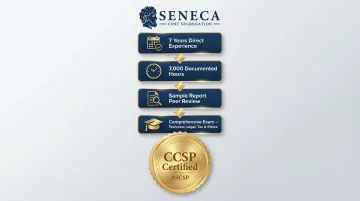
The Certified Cost Segregation Professional (CCSP) designation issued by the American Society of Cost Segregation Professionals (ASCSP) represents the industry's primary credential. Earning CCSP certification requires:
| Requirement | Details |
|---|---|
| Experience | Minimum 7 years of direct cost segregation experience |
| Hours | Documentation of at least 7,000 hours of direct study work |
| Peer Review | Submission of sample reports for peer review |
| Examination | Passing a comprehensive exam covering technical, legal, tax, and ethics issues |
| Continuing Education | Annual continuing education (10 Professional Development Units) |
Only CCSP-certified professionals can stamp reports with the official ASCSP seal, a direct signal to the IRS that the study was prepared to defined industry standards.
Example: Seneca Cost Segregation's Multidisciplinary Approach
Seneca Cost Segregation holds CCSP certification through the ASCSP and employs licensed professional engineers on staff. The firm was founded by real estate investors and construction professionals with over 12 years of hands-on experience, meaning studies are grounded in both technical accuracy and practical investment context.
The 3 Types of Cost Segregation Providers
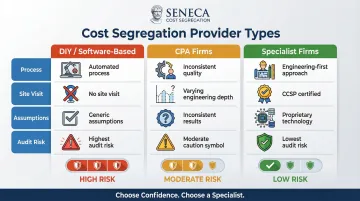
Not all cost segregation providers deliver the same quality, and the difference has real consequences for your tax position and audit exposure. Here's how the three main categories break down.
Option 1: DIY or Software-Based Providers
Software-based providers offer automated tools that estimate accelerated depreciation without physical site inspections or engineering analysis. These platforms rely on statistical modeling and "rule-of-thumb" percentages to allocate costs.
The problems with this approach:
- Missed assets that require physical inspection to identify
- Incorrect classifications based on generic assumptions
- Thin documentation that fails IRS scrutiny
- No engineer credentials backing the analysis
The IRS explicitly warns examiners to "view this approach with caution since it lacks sufficient documentation." Software-only studies represent the highest audit risk category.
Option 2: CPA Firms
Large CPA firms with in-house engineers and dedicated cost segregation departments can produce high-quality, defensible studies. However, most general practice CPAs lack the engineering depth required.
A Journal of Accountancy article warns that "an accountant's ad hoc cost segregation calculation or reliance on a contractor... is a recipe for disaster on examination."
When CPA firms work well:
- They have dedicated cost segregation departments
- Licensed engineers are on staff (not outsourced)
- The firm has documented experience in your property type
Without those conditions in place, results often fall short:
- General practitioners attempt studies without engineering support
- The firm treats cost segregation as an occasional side service
- Invoice-based methods replace physical inspections
Option 3: Specialist Cost Segregation Firms
Specialist firms focus exclusively on cost segregation, often delivering the most thorough results. Their advantages include:
- Dedicated teams with deep specialization
- Proprietary technology built specifically for component identification
- Industry-specific experience across multiple property types
- Faster turnaround (typically 2-4 weeks)
- Engineering-first methodology that identifies more assets
Seneca Cost Segregation, for example, has completed over 10,200 studies with an average first-year deduction of $171,243. That volume of experience builds the kind of pattern recognition where engineers spot components that generalists routinely overlook.
Provider Comparison at a Glance
| Feature | DIY/Software | CPA Firms | Specialist Firms |
|---|---|---|---|
| Physical Site Inspection | No | Sometimes | Yes |
| Licensed Engineers on Staff | No | Sometimes | Yes |
| CCSP Credentials | No | Rare | Standard |
| Audit Risk | Highest | Moderate | Lowest |
| Turnaround Time | Fast | Variable | 2–4 weeks |
| IRS Documentation Quality | Thin | Variable | Comprehensive |
What to Look For When Choosing a Cost Segregation Firm
| Selection Criterion | Key Indicators |
|---|---|
| Team Composition | Licensed engineers and tax professionals on every study |
| Credentials | PE license, CCSP designation |
| Property-Type Experience | Documented experience in the specific property type |
| Methodology | Engineering-based; physical site inspections (not invoice-only) |
| Audit Protection | Audit defense guarantee with money-back component |
| Track Record | Volume of studies completed, average first-year deduction, referral rates |
Multidisciplinary Team Composition
A qualified firm has both licensed engineers and tax professionals working on each study. Key questions to evaluate team composition include:
- Who performs the site visit?
- What are their credentials (PE license, CCSP designation)?
- Who prepares the tax documentation?
- How does the team coordinate between engineering and tax analysis?
Property-Type Experience
The firm should have documented experience with your specific property type: multi-family, commercial retail, short-term rental, industrial, medical office, or hospitality. Generic experience alone is not sufficient.
Seneca has completed studies across diverse property classes, including documented case studies for mobile home parks ($1.87M property generating $91,993 in first-year savings), residential rentals, and commercial properties. Potential providers can be evaluated by requesting examples in the relevant asset class.
Engineering-Based Methodology vs. Invoice-Based Methodology
An engineering approach examines actual construction elements such as linear feet of wiring, individual MEP components, and land improvements, rather than simply reading line items off invoices. The difference in tax savings can be substantial.
The Journal of Accountancy case study illustrates this gap: an engineering-based study on a $12.135 million property successfully reclassified $850,000 into 5- and 15-year property, yielding $133,563 in net-present-value tax savings compared to standard straight-line depreciation. Invoice-based methods routinely miss these opportunities.
Key differentiators of engineering-based studies:
- Physical site inspections (3-6 hours or more for complex properties)
- Hundreds of photographs documenting building systems
- Detailed quantity take-offs and measurements
- Cost reconciliation to total project cost
- Component-by-component classification tied to IRS asset class lives
Audit Protection
The report must include thorough, IRS-compliant documentation that holds up independently under scrutiny. Explicit audit support is the baseline; an audit defense guarantee with a money-back component is a stronger signal of confidence in the firm's methodology.
Seneca Cost Segregation offers an AuditDefense program that includes audit support and a money-back component, demonstrating confidence in their methodology and documentation standards.
Track Record and References
Audit protection is only as credible as the firm's track record. Track record metrics to evaluate include:
- Number of studies completed (Seneca: 10,200+)
- Average first-year deduction achieved (Seneca: $171,243)
- Client referral rates (Seneca: 95%)
- Verifiable reviews and testimonials
- References from clients with similar property types
Those numbers tell you whether a firm's methodology actually delivers, not just in ideal cases, but at scale across varied property types.
Red Flags: Warning Signs of a Low-Quality Provider
| Red Flag | Risk |
|---|---|
| Percentage-based fee structure | Triggers IRS scrutiny; prohibited by Treasury Circular 230 |
| No site visit or rushed site visit | Missed component reclassifications; lower deductions |
| Thin or generic reports (10–20 pages) | Insufficient documentation for audit defense |
Percentage-Based Fee Structure
The IRS explicitly discourages contingent fees tied to the amount of depreciation found. Treasury Circular 230 prohibits practitioners from charging contingent fees for services rendered in connection with an original tax return.
The IRS Cost Segregation Audit Techniques Guide warns: "Contingency fee arrangements create the incentive to maximize the amount of costs attributed to § 1245 property, usually through 'aggressive' legal interpretations and/or by inappropriate cost or estimation techniques. Accordingly, examiners should closely scrutinize studies performed on contingency fees."
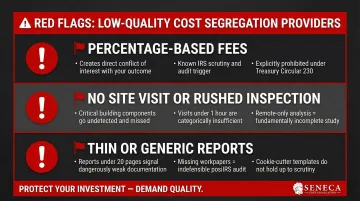
Flat, scope-based fees are the standard for legitimate cost segregation providers. Percentage-based pricing creates conflicts of interest and flags your study for heightened IRS scrutiny. Percentage-based pricing creates conflicts of interest and flags your study for heightened IRS scrutiny. That fee structure problem is just the first warning sign: how a provider conducts the physical site work matters just as much.
No Site Visit or a Rushed Site Visit
A thorough site visit for a moderately complex property takes 3–6 hours minimum. Engineers must:
- Photograph building components and systems
- Take detailed measurements
- Examine underground utilities and off-site improvements
- Identify removable versus built-in components
- Document construction quality and methods
Any provider claiming they can complete a study remotely from invoices alone, or promising to finish in under an hour, will miss components that belong in shorter depreciation classes. Those missed reclassifications translate directly into deductions you leave on the table. The quality of the final report reflects the quality of this fieldwork.
Thin or Generic Reports
A properly documented cost segregation report can exceed 100 pages and includes:
- Executive summary with preparer credentials
- Detailed narrative explaining methodology
- Itemized asset breakdown with assigned values
- Cost reconciliation workpapers
- Photographs and visual documentation
- Engineering calculations and quantity take-offs
- Tax forms ready for filing (Form 4562 or Form 3115)
A short report (10–20 pages) signals incomplete analysis. The IRS expects comprehensive documentation, and a thin deliverable leaves you without the supporting workpapers needed to defend the study if it's ever questioned. A sample report reveals the depth and quality of the firm's documentation.
How Much Does a Cost Segregation Study Cost?
Primary Pricing Variables
Fees vary based on:
- Property type (residential vs. commercial vs. specialized)
- Square footage and number of buildings
- Construction complexity (simple warehouse vs. hospital with specialized MEP)
- Documentation availability (complete records vs. missing blueprints)
- Site visit requirements (virtual vs. in-person inspection)
Representative fee ranges by property tier:
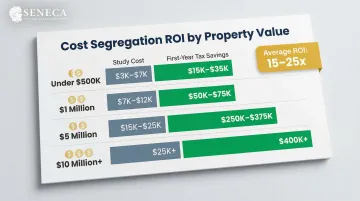
| Property Value | Typical Study Cost | Expected First-Year Savings |
|---|---|---|
| Under $500K | $3,000 - $7,000 | $15,000 - $35,000 |
| $1 Million | $7,000 - $12,000 | $50,000 - $75,000 |
| $5 Million | $15,000 - $25,000 | $250,000 - $375,000 |
| $10 Million+ | $25,000+ | $400,000+ |
ROI Is the Right Framing
The cost of the study should always be weighed against the expected first-year deduction. Seneca's reported average of $171,243 in first-year deductions illustrates that a $7,000-$12,000 study fee can yield 15-25 times that amount in tax savings in year one alone.
Over the full property hold period, the net present value of accelerated depreciation typically exceeds 10-20 times the study cost.
Upfront Cost vs. Total Value
Choosing a lower-cost provider that uses an invoice-based method or skips the site visit may save $2,000-$3,000 on the study but result in $30,000-$50,000 in missed deductions. The fee difference between a low-quality and high-quality study is almost always smaller than the deductions left on the table.
Seneca's free preliminary consultation gives you a concrete savings estimate before you spend a dollar, so the ROI case is clear upfront.
Frequently Asked Questions
Who prepares a cost segregation study?
Cost segregation studies are prepared by a team of licensed engineers who handle site analysis and asset classification, alongside CPAs or tax professionals who apply the relevant tax code. The IRS recognizes engineering expertise as a reliability marker, noting that studies conducted by construction engineers are more defensible than those without engineering backgrounds.
How much does it cost to get a cost segregation study done?
Fees vary based on property size and complexity, typically ranging from $3,000–$7,000 for properties under $500K to $25,000+ for properties exceeding $10 million. The study cost is typically a small fraction of the first-year tax savings it generates; most studies deliver 10:1 to 25:1 ROI in year one alone.
What is the difference between an engineering-based and invoice-based cost segregation study?
An engineering-based study analyzes individual building components through physical site inspections, measurements, and component-by-component classification. An invoice-based approach only reviews listed costs on invoices, missing assets that aren't separately itemized, and consistently produces lower, less defensible deductions as a result.
What credentials should I look for in a cost segregation provider?
The CCSP (Certified Cost Segregation Professional) designation from the ASCSP, licensed professional engineers on staff (not just CPAs), and membership in recognized engineering or tax organizations are key credentials to verify. The CCSP is the industry's gold standard, requiring 7 years of experience, 7,000 documented hours, and a comprehensive exam to earn.
What happens if the IRS audits my cost segregation study?
A well-prepared, engineering-based study with thorough documentation is the strongest defense against an IRS challenge. The IRS Cost Segregation Audit Techniques Guide makes clear that studies with engineering credentials and comprehensive documentation are held to a higher standard of reliability. Providers offering audit support, and ideally a money-back audit defense guarantee, demonstrate confidence in their methodology.