

Introduction
Real estate investors who've never run a cost segregation study are often sitting on $100,000 or more in unclaimed deductions. Retroactive studies exist to recover exactly that.
With the One Big Beautiful Bill Act (OBBBA) restoring 100% bonus depreciation for qualifying properties placed in service after January 19, 2025, and Form 3115 allowing look-back claims without amending prior returns, the window to recapture missed depreciation has rarely been this wide.
The TCJA phase-down is still in effect. If a taxpayer acquired a property before January 19, 2025, and places it into service after January 19, 2025 in 2025 or 2026, they will experience 40% bonus depreciation and 20% bonus depreciation, respectively.
This guide ranks the top 10 firms for retroactive cost segregation studies, covering methodology, credentials, and what sets each one apart. Whether you own a single-family rental, a multi-family complex, or a commercial property, the right firm can recover years of missed deductions in a single filing.
TL;DR
- Retroactive studies recover missed depreciation on properties you already own, often going back many years
- Form 3115 and IRC Section 481(a) adjustments eliminate the need to amend prior tax returns
- Best firms combine engineering-based methodology, CCSP credentials, and proven Form 3115 experience
- Seneca Cost Segregation stands out with 10,200+ completed studies, an audit protection guarantee, and a 2–4 week turnaround
- Other top firms include ETS, KBKG, Capstan, and more, each profiled below with key selection criteria
What Is a Retroactive Cost Segregation Study?
A retroactive cost segregation study is performed on a property that has already been placed in service (sometimes years ago) to identify and "catch up" on accelerated depreciation deductions that were never claimed. Unlike a standard cost segregation study conducted at acquisition, retroactive studies require specific IRS compliance mechanics to recover missed benefits legally.
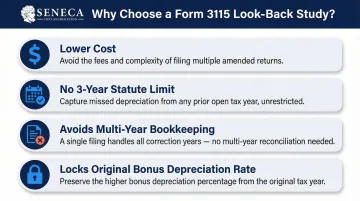
There are two paths to claim retroactive benefits: a look-back study using Form 3115 with an IRC Section 481(a) adjustment filed on your current return, or a retroactive amendment of a prior-year return. Form 3115 is usually the better choice because it:
- Costs less than amending multiple prior returns
- Isn't limited by the standard 3-year statute of limitations
- Avoids multi-year bookkeeping complications
- Locks the bonus depreciation rate to the property's original placed-in-service year, not the year the study is done
Two Paths to Claim Retroactive Benefits: Comparison
| Feature | Look-Back Study (Form 3115 + Section 481(a)) | Retroactive Amendment |
|---|---|---|
| Filing | Filed on current tax return | Amends a specific prior-year return |
| Statute of Limitations | No statutory limit | Typically capped at 3 years |
| Cost | Costs less than amending multiple prior returns | Requires amending multiple prior returns |
| Bookkeeping | Avoids multi-year bookkeeping complications | Multi-year bookkeeping complications possible |
| Bonus Depreciation Rate | Locked to the property's original placed-in-service year | Locked to the property's original placed-in-service year |
Bonus Depreciation Timeline
| Period | Bonus Depreciation Rate | Condition |
|---|---|---|
| September 27, 2017 – December 31, 2022 | 100% | — |
| January 1, 2023 – December 31, 2023 | 80% | — |
| January 1, 2024 – December 31, 2024 | 60% | — |
| January 1, 2025 – January 18, 2025 | 40% | — |
| January 19, 2025 – December 31, 2030 | 100% | Acquisition date must be January 19, 2025 or later |
| 2025 | 40% | Acquisition date before January 19, 2025 |
| 2026 | 20% | Acquisition date before January 19, 2025 |
Because retroactive cost segregation involves specific IRS compliance mechanics (Form 3115, Section 481(a), and bonus depreciation rate lookups by placed-in-service year), choosing a firm with proven look-back methodology is what separates a clean IRS filing from a costly mistake. The firms below were selected based on documented experience with retroactive studies and Form 3115 filings specifically.
Top 10 Firms for Retroactive Cost Segregation Studies
Firms were evaluated on engineering-based methodology, ASCSP/CCSP credentials, demonstrated retroactive/look-back study experience, IRS audit defense capabilities, turnaround time, nationwide service coverage, and client satisfaction track record.
All Firms at a Glance
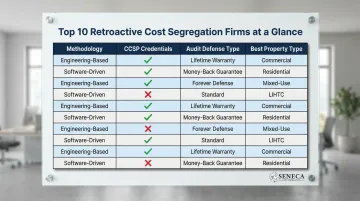
| Firm | Key Credentials | Audit Defense | Best Suited For |
|---|---|---|---|
| Seneca Cost Segregation | CCSP-certified, 10,200+ studies, veteran-owned | AuditDefense money-back guarantee | Residential and commercial investors, STR/LTR owners, multi-family, owner-occupied commercial, all 50 states |
| Engineered Tax Services (ETS) | Licensed engineering firm since 2001, national footprint | Included | Commercial, residential, and industrial property owners |
| KBKG | Multiple CCSP principals, ASCSP board members | — | Investors seeking technology-enabled solutions and high-volume portfolio processing |
| Capstan Tax Strategies | CCSP team, CPA collaboration focus | Capstan Warranty (no-cost) | Commercial real estate investors, especially multifamily, retail, and industrial |
| Cost Segregation Authority (CSA) | CPAs and engineers, construction industry veterans | No-cost, 100% backed | Property owners seeking construction-informed analysis with strong audit protection |
| Madison SPECS | 60+ professionals, in-house engineers | Perfect IRS audit track record | Property owners who value thorough on-site analysis and proven audit defense |
| Veritax Advisors | CPA-founded, engineering team on staff | "Forever" unlimited duration | Investors seeking unlimited audit protection and CPA-led tax strategy integration |
| BDO USA | Licensed PEs and CPAs, national accounting firm | Included | Large enterprises, multi-state portfolios, investors requiring SALT coordination |
| Novogradac | ASCSP members, LIHTC and affordable housing expertise | — | LIHTC properties, affordable housing investors, complex partnership structures |
| Forvis Mazars | PEs and CPAs, national firm resources | — | Multifamily, healthcare, and hospitality property owners |
Seneca Cost Segregation
Background: Seneca Cost Segregation is a veteran-owned firm co-founded by real estate investors with over 12 years of cost segregation experience. The firm maintains CCSP-certified team members, licensed professional engineers on staff, and deploys engineering-based methodology across all 50 states. With over 10,200 completed studies and a 95% client referral rate, Seneca has established a strong track record in the retroactive study space.
Differentiators: Seneca's retroactive studies leverage proprietary in-house technology built by engineers and tested for IRS compliance, delivering an average first-year deduction of $171,243. Studies are completed within 2–4 weeks and backed by an AuditDefense money-back guarantee, a level of risk protection rarely offered in this space. The firm reports zero clients audited following their studies, a result that reflects the rigor of their engineering-based methodology.
| Category | Details |
|---|---|
| Methodology | Engineering-based, proprietary tech-assisted, IRS-compliant look-back analysis |
| Key Strengths | 10,200+ studies completed, CCSP-certified, AuditDefense guarantee, 2–4 week turnaround, complimentary tax assessments |
| Best Suited For | Residential and commercial investors, STR/LTR owners, multi-family, and owner-occupied commercial properties across all 50 states |

Engineered Tax Services (ETS)
Background: Founded in 2001 and headquartered in West Palm Beach, FL, ETS operates as a licensed engineering firm specializing in tax strategies. The firm has built a national reputation as one of the largest specialty tax consulting engineering firms in the U.S., with a dedicated cost segregation division serving property owners nationwide.
Differentiators: ETS utilizes an engineering-based methodology that includes site analysis and construction document review. For retroactive studies, ETS assists CPAs in filing Form 3115 to claim missed depreciation under IRC Section 481(a). The firm defends its work against IRS audits and serves a wide range of property types, including commercial, residential, and industrial properties.
| Category | Details |
|---|---|
| Methodology | Engineering-based with site analysis and construction document review |
| Key Strengths | Licensed engineering firm since 2001, national footprint, free analysis and consultation, audit defense included |
| Best Suited For | Commercial, residential, and industrial property owners seeking comprehensive engineering analysis |
KBKG
Background: Established in 1999 and headquartered in Pasadena, CA, KBKG has multiple CCSP-credentialed principals on staff and has built a reputation for technical sophistication in the cost segregation space. Multiple KBKG experts serve on the board of the American Society of Cost Segregation Professionals, demonstrating their leadership in the industry.
Differentiators: KBKG is highly software-enabled, offering a proprietary 481(a) Adjustment Calculator to streamline Form 3115 filings, alongside their Residential Cost Segregator and Cost Seg Pro tools. The firm strictly adheres to engineering-based methodologies, explicitly rejecting rule-of-thumb approaches that the IRS views with caution. KBKG provides independent third-party analysis to ensure objectivity and compliance.
| Category | Details |
|---|---|
| Methodology | Engineering-based with proprietary software tools including 481(a) Adjustment Calculator |
| Key Strengths | Multiple CCSP principals, ASCSP board members, proprietary technology platform, established since 1999 |
| Best Suited For | Investors seeking technology-enabled solutions and high-volume portfolio processing |
Capstan Tax Strategies
Background: Based in Dresher, PA, Capstan employs a team of engineers and CCSPs focused on maximizing tax benefits for real estate investors. The firm positions itself as a trusted resource to CPAs and their clients, emphasizing collaboration with tax professionals throughout the engagement process.
Differentiators: Capstan explicitly prepares the required Form 3115 tax documentation for look-back studies. A major differentiator is the "Capstan Warranty," which guarantees no-cost IRS audit support for their clients. The firm specializes in commercial real estate, including multifamily, retail, and industrial properties, with a focus on engineering rigor and compliance depth.
| Category | Details |
|---|---|
| Methodology | Engineering-based with detailed Form 3115 preparation for retroactive claims |
| Key Strengths | CCSP team, "Capstan Warranty" with no-cost audit support, CPA collaboration focus |
| Best Suited For | Commercial real estate investors, especially multifamily, retail, and industrial property owners |
Cost Segregation Authority (CSA)
Background: Founded in 2006 and headquartered in Lindon, UT, CSA was built by construction industry veterans who bring practical building knowledge to the cost segregation process. The firm combines CPAs and engineers to deliver tax strategy services grounded in hands-on construction experience.
Differentiators: CSA provides retroactive services that include detailed depreciation schedules, 481(a) calculations, and Form 3115 preparation. The firm explicitly advertises "no-cost audit support" and backs their work 100%, demonstrating confidence in their methodology. Their construction industry background directly informs how they classify components and allocate costs, an advantage when auditors question specific line items.
| Category | Details |
|---|---|
| Methodology | Engineering-based analysis by construction industry veterans with comprehensive 481(a) calculations |
| Key Strengths | CPAs and engineers on staff, 100% backed work, no-cost audit support, construction industry expertise |
| Best Suited For | Property owners seeking construction-informed analysis with strong audit protection |
Madison SPECS
Background: Operating nationally from its New Jersey headquarters since 2006, Madison SPECS utilizes a team of over 60 professionals, including in-house engineers who conduct mandatory on-site property tours. The firm has built a reputation for thorough, hands-on analysis rather than desktop estimates.
Differentiators: Madison SPECS handles retroactive catch-up depreciation via Form 3115 and reports that no client has ever had to make a change due to an IRS audit. The firm's mandatory site visit policy ensures accuracy and generates the detailed documentation the IRS expects during examination. That combination of on-site documentation and a 60-person engineering team supports one of the stronger audit defense records in the industry.
| Category | Details |
|---|---|
| Methodology | Engineering-based with mandatory on-site property tours and Form 3115 catch-up depreciation |
| Key Strengths | 60+ professionals, in-house engineers, perfect IRS audit track record, mandatory site visits |
| Best Suited For | Property owners who value thorough on-site analysis and proven audit defense |
Veritax Advisors
Background: A boutique firm led by a CPA founder and based in Southern Utah, Veritax Advisors utilizes an engineering-based approach to reclassify assets for maximum tax benefit. The firm combines accounting expertise with engineering analysis to deliver integrated tax strategy services that connect depreciation planning with broader CPA workflows.
Differentiators: Veritax provides completed 481(a) adjustments and Form 3115 support for retroactive studies. The firm stands out by offering "Forever" audit defense, meaning they will defend their work until the conclusion of an IRS audit, with no time limit. For investors in higher-value or complex properties where audit risk is elevated, that open-ended commitment carries real weight.
| Category | Details |
|---|---|
| Methodology | Engineering-based asset reclassification with completed 481(a) adjustments and Form 3115 support |
| Key Strengths | CPA-founded firm, "Forever" audit defense with unlimited duration, engineering team on staff |
| Best Suited For | Investors seeking unlimited audit protection and CPA-led tax strategy integration |
BDO USA
Background: BDO offers a large national footprint with a dedicated Fixed Asset Advisory Services team featuring licensed Professional Engineers (PEs) and CPAs. As a large national accounting firm, BDO brings deep resources and multi-state compliance capability to complex cost segregation engagements.
Differentiators: BDO performs engineering-based studies and handles Form 3115 catch-up deductions with direct coordination into broader tax planning. The firm is well-suited for large enterprises that need to align cost segregation with complex State and Local Tax (SALT) apportionment.
BDO's infrastructure also addresses state-level depreciation decoupling, a frequent complication for multi-state portfolios that smaller specialty firms may not handle in-house.
| Category | Details |
|---|---|
| Methodology | Engineering-based studies by licensed PEs and CPAs with Form 3115 catch-up deductions |
| Key Strengths | National firm infrastructure, SALT integration, multi-state compliance expertise, enterprise-scale resources |
| Best Suited For | Large enterprises, multi-state portfolios, and investors requiring SALT coordination |
Novogradac
Background: A national CPA and advisory firm, Novogradac specializes heavily in real estate, especially Low-Income Housing Tax Credits (LIHTC) and affordable housing. The firm's cost segregation specialists perform both prospective and retroactive studies, utilizing physical walk-throughs and detailed cost record reviews.
Differentiators: Novogradac's deep integration with complex real estate tax credits and partnership structuring makes them well-qualified for affordable housing and LIHTC properties. Their cost segregation practice works closely with their broader real estate advisory services, connecting depreciation optimization with tax credit compliance and partnership-level planning. ASCSP members on staff bring specialized knowledge of how depreciation elections interact with tax credit allocations, a niche that few cost segregation firms can address.
| Category | Details |
|---|---|
| Methodology | Engineering-based with physical walk-throughs and detailed cost record reviews for prospective and retroactive studies |
| Key Strengths | LIHTC and affordable housing expertise, ASCSP members, comprehensive real estate tax integration |
| Best Suited For | LIHTC properties, affordable housing investors, and complex partnership structures |
Forvis Mazars
Background: Forvis Mazars deploys a team of engineers and CPAs to conduct IRS-recognized engineering-based studies. As a large national firm, they bring significant resources and established audit standards to the cost segregation process.
Differentiators: Forvis Mazars explicitly handles retroactive cost segregation through changes in accounting methods to capture missed depreciation. The firm highlights deep expertise in multifamily housing, healthcare, and hospitality portfolios, with specialized knowledge of the depreciation opportunities specific to each sector. Their national infrastructure supports multi-state compliance and coordination with broader real estate tax planning.
| Category | Details |
|---|---|
| Methodology | Engineering-based studies by PEs and CPAs with retroactive accounting method changes |
| Key Strengths | National firm resources, multifamily/healthcare/hospitality expertise, established audit standards |
| Best Suited For | Multifamily, healthcare, and hospitality property owners requiring sector-specific expertise |
How We Chose These Firms
Retroactive cost segregation is technically distinct from a standard forward-looking study. The right firm needs hands-on expertise in Form 3115 filings, IRC Section 481(a) adjustments, look-back mechanics, and bonus depreciation rate application by placed-in-service year. Firms that rely on rule-of-thumb methods rather than engineering-based analysis represent one of the most common and costly mistakes investors make when choosing a provider.
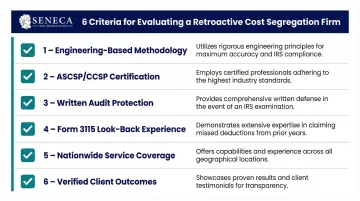
Core evaluation criteria included:
- Uses engineering-based methodology: the IRS explicitly warns against rule-of-thumb approaches in Publication 5653 (Cost Segregation Audit Techniques Guide)
- Holds ASCSP membership and CCSP certification, the industry's highest credential requiring 7,000+ hours of experience and peer review
- Offers written audit protection (AuditDefense or equivalent) to cover clients if the IRS questions the study
- Has direct experience with Form 3115 and look-back filings; not all firms understand the filing mechanics of retroactive claims
- Serves clients efficiently across all 50 states with reasonable turnaround times
- Backs results with verified client outcomes or referral rates
Not every firm on the market meets these standards. Firms that cannot explain the difference between a look-back and a retroactive amendment, those without ASCSP credentials, and those without a clear audit protection policy do not meet these criteria. These gaps typically surface when the IRS starts asking questions — and at that point, switching providers is not an option.
Conclusion
Retroactive cost segregation remains an underused recovery strategy for real estate investors, particularly given the OBBBA's restoration of 100% bonus depreciation, which makes the look-back opportunity for properties placed in service in eligible years more valuable than ever. The difference between a well-executed retroactive study and a deficient one can mean hundreds of thousands of dollars in recovered deductions versus an IRS audit with penalties.
These factors carry more weight than brand recognition or lowest fee alone:
- Engineering-based methodology (not software-only estimates)
- CCSP credentials from the ASCSP
- Demonstrated Form 3115 experience for look-back studies
- Clear, written audit defense policies
The firms profiled above each meet these standards and have documented track records with retroactive engagements specifically.
Ready to recover missed depreciation? Seneca Cost Segregation offers a complimentary tax assessment and has delivered an average first-year deduction of $171,243 across 10,200+ studies. Seneca's team is reachable at senecacostseg.com or by calling 530-797-6539.
Frequently Asked Questions
What is a retroactive cost segregation study?
A retroactive cost segregation study is performed on a property already in service to recover previously unclaimed accelerated depreciation. The two main paths are a look-back study using Form 3115 and IRC Section 481(a) on the current return, or amending prior-year returns, each applying the bonus depreciation rate tied to the property's original placed-in-service year, not the year of the study.
Can you do a cost segregation study retroactively on an existing property?
Yes. Any commercial or residential investment property that has been placed in service is generally eligible, regardless of how long ago. Form 3115 enables look-back claims on the current return with no statutory time limit, while amended returns are typically capped at three years.
How much does a retroactive cost segregation study cost?
Fees vary by firm and property complexity, typically starting around $3,000–$8,000 for residential properties and $5,000–$15,000+ for commercial properties. Most reputable firms offer a free feasibility assessment first, and the ROI on a well-executed study generally far exceeds the study cost, often delivering $10–$25 in tax savings for every dollar spent.
Who should I hire for a retroactive cost segregation study?
Firms with ASCSP membership and CCSP certification, licensed engineers on staff, demonstrated Form 3115 experience for look-back claims, and a clear audit defense policy are well-suited for this work. Seneca Cost Segregation meets each of these criteria, serving clients in all 50 states with an engineering-based methodology and an AuditDefense money-back guarantee.
What is the difference between a look-back and a retroactive cost segregation study?
A look-back study catches up missed depreciation in the current tax year via Form 3115 and a Section 481(a) adjustment, while a retroactive study involves amending a specific prior-year return. Look-back is generally preferred for its simplicity, lower cost, unlimited reach back in time, and avoidance of the three-year statute of limitations on amended returns.
How far back can a retroactive cost segregation study go?
Using Form 3115, there is no statutory limit. Properties placed in service as far back as 1987 can qualify. Amended returns, by contrast, are typically capped at three years, and the applicable bonus depreciation rate is always tied to the original placed-in-service year.