
The problem is straightforward: not all cost segregation providers operate at the same standard. Some skip site inspections. Others use percentage-based fees that the IRS explicitly flags as high-risk. Many deliver thin, template-driven reports that lack the engineering-based documentation the IRS expects. This post covers what expert cost segregation services actually look like, the criteria that matter when choosing a provider, and the red flags to watch for before signing on.
TLDR
- Expert cost segregation requires engineering-based analysis, IRS-compliant documentation, and strategic tax consultation
- ASCSP certification (CCSP designation) and verifiable experience are the most reliable indicators of provider quality
- A legitimate study includes a site inspection, asset-by-asset classification, and workpapers your CPA can use during filing
- Look-back studies allow property owners who missed cost segregation in prior years to reclaim missed deductions with a catch-up adjustment
- Audit defense and money-back guarantees protect your deductions if the IRS asks questions
What Expert Cost Segregation Services Actually Involve
Cost segregation is a tax strategy that reclassifies components of a real property from a standard 27.5-year (residential) or 39-year (commercial) depreciation schedule into 5-, 7-, or 15-year asset classes. The strategy is IRS-recognized and has its own Audit Techniques Guide, making it a well-established method for accelerating deductions and freeing up immediate cash flow.
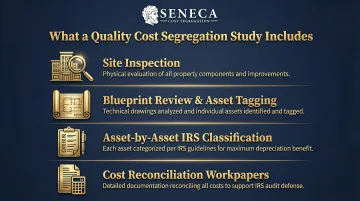
What distinguishes an expert-level study from a basic or software-generated one is the engineering-based approach. A quality study includes:
- Physical or virtual site inspection to document actual property components
- Blueprint review and component-level asset tagging by licensed engineers
- Asset-by-asset classifications with clear IRS rationale for each decision
- Cost reconciliation workpapers that tie back to your purchase price
The IRS explicitly states that "a study by a construction engineer is more reliable than one conducted by someone with no engineering or construction background". Desktop-only studies that rely on publicly available data or rough estimates lack the documentation the IRS expects during an audit.
Look-back studies offer a powerful opportunity for property owners who acquired or improved a property in prior years. You can still perform a cost segregation analysis retroactively and file a catch-up depreciation deduction via Form 3115 (Application for Change in Accounting Method), without amending prior returns.
Bonus depreciation multiplies the value of cost segregation. The TCJA phase-down is still in effect. If a taxpayer acquired a property before January 19, 2025, and places it into service after January 19, 2025 in 2025 or 2026, they will experience 40% bonus depreciation and 20% bonus depreciation, respectively. For qualifying property with an acquisition date of January 19, 2025 or later, 100% bonus depreciation applies through December 31, 2030. When paired with a cost segregation study, this allows investors to deduct the entire accelerated portion in the year the study is completed, putting those tax savings to work right away.
Bonus Depreciation Timeline
| Period | Bonus Depreciation Rate | Notes |
|---|---|---|
| September 27, 2017 – December 31, 2022 | 100% | TCJA full bonus depreciation |
| January 1, 2023 – December 31, 2023 | 80% | TCJA phase-down |
| January 1, 2024 – December 31, 2024 | 60% | TCJA phase-down |
| January 1, 2025 – January 18, 2025 | 40% | TCJA phase-down |
| January 19, 2025 – December 31, 2030 | 100% | Applies if acquisition date is January 19, 2025 or later |
| 2025 (acquisition before January 19, 2025) | 40% | TCJA phase-down still in effect |
| 2026 (acquisition before January 19, 2025) | 20% | TCJA phase-down still in effect |
Property Types That Benefit Most
Cost segregation generates the most significant results for:
- Multifamily apartment buildings
- Commercial office and retail spaces
- Short-term rentals (STRs) and hospitality properties
- Industrial and warehouse facilities
- Owner-occupied business properties
Minimum property value threshold: Industry practitioners typically cite a minimum depreciable basis of $500,000 to $1,000,000 for a full engineering study to yield positive ROI net of study fees. Below this threshold, study costs may consume a disproportionate share of the tax savings generated. Properties with extensive specialty equipment, tenant improvements, or site work yield the highest reclassifications—often 20–30% of basis reclassified to 5- or 15-year property.
What to Look for When Evaluating a Cost Segregation Provider
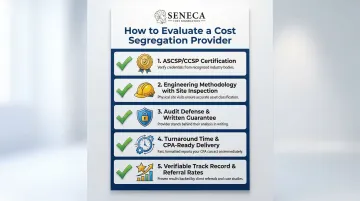
Not all cost segregation providers deliver the same quality—or the same IRS compliance. The following five criteria serve as benchmarks for evaluating provider quality:
| Criterion | Description | Red Flag |
|---|---|---|
| ASCSP Certification | The Certified Cost Segregation Professional (CCSP) designation requires 7+ years and 7,000 hours of direct experience, a rigorous two-part exam, and peer recommendations. | Firms without at least one CCSP on staff lack this credential. |
| Engineering methodology | A qualified provider conducts site inspections (physical or virtual), reviews blueprints, and produces asset-level documentation. The IRS Audit Techniques Guide outlines 13 elements of a quality study — engineering competence is central to all of them. | Desktop-only analysis is a red flag. |
| Audit defense and IRS compliance | Audit defense inclusion and a written guarantee are indicators of a provider's IRS compliance confidence. | Providers who sidestep this conversation represent real risk on high-value deductions. |
| Turnaround time and delivery | Elite providers complete studies within 2-4 weeks and deliver reports formatted for direct CPA integration, not PDFs that require interpretation before they're usable. | — |
| Track record and client proof | Verifiable numbers—studies completed, average first-year deduction achieved, and client referral rates—indicate a credible track record. | General claims without supporting data aren't enough. |
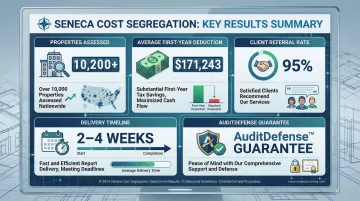
Seneca Cost Segregation holds the CCSP designation, includes AuditDefense with a money-back guarantee, and has completed over 10,200 studies with a 95% client referral rate, meeting every standard on this list.
Red Flags That Signal a Subpar Study
| Red Flag | Why It Matters |
|---|---|
| The provider skips the site inspection | Any firm that says they can complete a study from publicly available data or a quick desktop analysis is cutting corners. Accurate asset reclassification requires a site-level review (whether in-person or virtual) to identify building components, quantify costs, and document everything the IRS would expect to see. |
| The fee is percentage-based | The IRS explicitly warns examiners to "closely scrutinize studies performed on contingency fees" because they incentivize aggressive classifications. Circular 230 §10.27 and AICPA Code 1.510 generally bar contingent fees for preparing original returns. A percentage-based fee creates a financial incentive to inflate estimates and marks the provider's report as potentially non-compliant from the start. |
| The report is thin or template-driven | A defensible cost segregation report typically exceeds 30 pages and includes asset schedules, engineering take-offs, cost reconciliation workpapers, legal citations, and supporting photographs. A short report means asset-level analysis wasn't done. A provider that cannot show a sample report or explain their classification methodology presents a significant concern. |
The Value of a True Cost Segregation Consultation
The consultation phase (before a study even begins) is where significant value is either created or missed. A qualified provider should assess your specific property, tax profile, and investment goals to determine whether cost segregation makes financial sense, and how to maximize the benefit when it does.
A thorough consultation goes beyond depreciation scheduling. Experienced providers review your broader tax situation and identify opportunities to layer in additional incentives, including bonus depreciation timing, 179D energy deductions, or 1031 exchange considerations, so the cost segregation study fits into a larger tax plan rather than sitting in isolation.
Direct collaboration with your CPA from the outset is equally important. The best consultations ensure study deliverables are formatted for accurate, efficient filing, and that every classification decision holds up from both an engineering and tax law standpoint. That alignment means your accountant can implement findings without delays or back-and-forth.
Why Seneca Cost Segregation Delivers Expert-Level Results
Seneca Cost Segregation is a veteran-owned, ASCSP-certified firm founded by real estate investors who have personally used cost segregation to optimize their own portfolios. Co-founders Paul Spies and Dylan Scandalios built Seneca to deliver that same tax advantage to investors nationwide.
Paul, a Marine Corps Sergeant with over 8 years of real estate construction expertise, flipped more than 150 homes in 4 years and led ground-up multi-family projects. He's used cost segregation personally since 2018. The firm employs licensed professional engineers and holds the CCSP designation.
Results-backed track record:
| Metric | Value |
|---|---|
| Properties assessed | Over 10,200 across all 50 states |
| Average first-year deduction | $171,243 |
| Client referral rate | 95% |
| Study turnaround time | 2-4 weeks |
| Guarantee | AuditDefense backed by a money-back guarantee |
Every engagement starts with a complimentary, no-obligation tax assessment. Certified advisors confirm whether a study makes financial sense for your specific property, then provide personalized tax strategy recommendations that go beyond depreciation, covering additional savings opportunities across your full portfolio.
Frequently Asked Questions
How much does a cost segregation study cost?
Fees vary by property type, size, and complexity, typically ranging from a few thousand dollars to over $15,000 for large or complex properties. The cost is nearly always outweighed by first-year tax savings, with typical ROI ranging from 10:1 to 25:1.
How do I choose the best cost segregation company?
ASCSP/CCSP credentials, an engineering-based methodology with site inspections, audit defense guarantees, and verifiable client results and referral rates are the key factors in evaluating provider quality. Providers who skip site visits or use percentage-based fees present compliance risks.
Does the IRS accept cost segregation studies?
Yes. Cost segregation is a well-established and IRS-recognized tax strategy with its own Audit Techniques Guide, provided the study is prepared by qualified professionals using engineering-based methodology and proper documentation.
Is cost segregation worth it?
For most property owners with buildings valued above $500,000, cost segregation generates significantly more in first-year tax savings than the cost of the study—especially when 100% bonus depreciation is factored in.
Can you do cost segregation on commercial property?
Yes. Commercial properties—including office buildings, retail, industrial, multifamily, and hospitality—are among the most common and beneficial candidates for cost segregation studies.
Can a CPA perform a cost segregation study?
Some large CPA firms with in-house engineers can perform studies. However, most CPAs lack the construction engineering background the IRS recommends, so a specialized engineering firm is typically the more defensible option for property owners.