For investors in the 37% federal bracket, every $100,000 in accelerated deductions translates to $37,000 in immediate tax savings. The catch? Passive loss rules prevent most high earners from using these deductions against W-2 wages or business income unless they meet specific criteria.
This guide covers the mechanics of cost segregation, the three pathways high-income investors can use to unlock the losses, realistic ROI math with real-world benchmarks, optimal timing, and compliance mistakes that invite IRS scrutiny.
TL;DR
- Cost segregation reclassifies building components from 27.5-year or 39-year schedules into 5-, 7-, or 15-year property
- 100% bonus depreciation is restored permanently for property acquired after January 19, 2025 — reclassified components can be fully expensed in year one
- Passive activity rules gate your savings — losses only offset income if you qualify as a Real Estate Professional, materially participate in STRs, or have passive income to absorb them
- Typical residential rentals yield 15-25% reclassification; commercial properties often reach 25-40%
- The acquisition year is optimal — retroactive studies are possible via Form 3115 but sacrifice time-value benefits
How Cost Segregation Works for Rental Properties
The IRS requires residential rental property to be depreciated over 27.5 years and commercial real estate over 39 years. This treats the entire building as a single long-lived asset, forcing investors to spread deductions across decades when the cash value of those deductions is highest in the early years of ownership.
A cost segregation study changes this equation. Licensed engineers and tax professionals analyze construction documents, blueprints, and physical property components, then reclassify building elements into shorter MACRS depreciation classes instead of treating them as structural components.
Typical Reclassifications
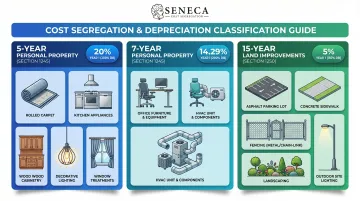
The IRS permits three main short-life categories:
5-year property (personal property under Section 1245):
- Carpet and vinyl flooring
- Appliances (refrigerators, dishwashers, ranges, microwaves)
- Removable cabinetry in kitchens and bathrooms
- Decorative lighting fixtures
- Window treatments and blinds
7-year property (personal property under Section 1245):
- Office furniture and fixtures
- Select HVAC components dedicated to specific equipment
15-year property (land improvements under Section 1250):
- Parking lots and driveways
- Sidewalks and walkways
- Fencing and gates
- Exterior landscaping and irrigation
- Site lighting and utilities
Standard residential rentals typically see 15-40% of building value reclassifiable depending on property type — residential rentals typically land at 15-25%, while commercial or mixed-use properties with heavier build-outs often reach 25-40%.
Bonus Depreciation: The Multiplier
Bonus depreciation can eliminate a property's taxable income entirely in year one — not just accelerate deductions. Once reclassified, current bonus depreciation rules allow the full amount to be deducted in the year the property is placed in service.
As of 2025, the One Big Beautiful Bill Act (OBBBA) permanently restored 100% bonus depreciation for qualified property acquired and placed in service after January 19, 2025. Properties acquired before that date remain subject to the TCJA phase-down schedule (40% for 2025).
Recapture at sale: When you sell, the IRS claws back accelerated deductions at the following rates:
- Section 1245 assets (5- and 7-year personal property) — recaptured at ordinary income rates
- Section 1250 assets (15-year land improvements) — subject to unrecaptured depreciation tax at a maximum 25% rate
Many investors use 1031 exchanges to defer this liability. However, exchanging a cost-segregated property requires matching sufficient personal property in the replacement asset — advance planning is essential.
The Three Ways High-Income Investors Can Actually Use the Losses
Generating a large paper loss through cost segregation means nothing if passive activity rules prevent you from using it. This is the single most important concept for high-income investors.
Under IRC §469, rental losses are generally passive and can only offset passive income—not W-2 wages, business income, or investment income. High earners above $150,000 MAGI face complete phase-out of the $25,000 passive loss allowance.
Without a strategy to reclassify those losses as non-passive, cost segregation generates suspended losses that sit unused until you sell the property or generate offsetting passive income.
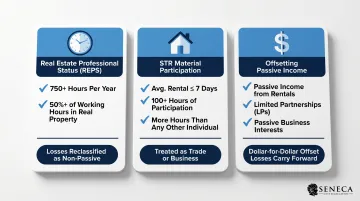
Real Estate Professional Status (REPS)
REPS qualification requires:
- More than 750 hours per year in real property trades or businesses
- More than 50% of all working hours in those activities
When REPS is met, rental losses are reclassified as non-passive, allowing them to offset W-2 wages, business income, or any other ordinary income without limitation.
Common misconception: REPS is per-taxpayer, not per-property. The spouse who qualifies does not need to be the one earning the high W-2 income. A surgeon or tech executive whose spouse actively manages properties can use this pathway—but the IRS requires contemporaneous time logs, not ballpark estimates.
Short-Term Rental (STR) Material Participation
For investors who own short-term rentals, there's a separate and often more accessible pathway. Properties rented for an average of 7 days or fewer per guest are not classified as rental activities under IRC §469(c)(2)—they are treated as a trade or business. That classification matters because material participation rules apply instead of the higher REPS threshold (750+ hours versus 100 hours).
The primary material participation test requires:
- At least 100 hours of participation in the activity
- More hours than any other individual involved in the activity
This pathway requires genuine active involvement. If a full-service property manager handles everything, material participation becomes much harder to establish — so document your role in guest communications, maintenance coordination, pricing decisions, and day-to-day operations.
Offsetting Passive Income From Other Investments
Investors who cannot qualify for REPS or STR material participation can still benefit when they have passive income from other sources:
- Other rental properties generating net income
- Limited partnership distributions
- Passive business interests
Cost segregation losses offset this passive income dollar-for-dollar. Even when losses cannot be used immediately, they carry forward indefinitely as suspended losses — fully released upon sale of the property or when you qualify for one of the active pathways above. Suspended losses preserve real dollar value, and in high-appreciation markets, those deductions are waiting precisely when the tax liability is largest.
ROI Math: What High-Income Investors Actually Save
Run these four steps on any qualifying property to get a fast read on your first-year return:
- Estimate the percentage of building value that can be reclassified
- Apply 100% bonus depreciation to arrive at a year-one deduction
- Multiply by your marginal tax rate to calculate first-year tax savings
- Compare against study cost ($5,000–$15,000 typical range) to determine ROI
Scenario: $750K Residential Rental
A $750,000 single-family or small multifamily rental with $600,000 allocated to the building (after land):
- At a 20% reclassification rate: $120,000 qualifies for immediate deduction
- At the 37% federal bracket: $44,400 in year-one tax savings
- Against a $7,500 study cost: approximately 6x ROI
For context, Seneca Cost Segregation's average first-year deduction across 10,200+ completed studies is $171,243—showing these results are achievable and common for qualifying properties.
Scenario: $2M Commercial or Multifamily
A $2,000,000 commercial property with a 30% reclassification rate:
- $600,000 in qualifying short-life components
- $222,000 in federal tax savings at the 37% rate
- Against a $10,000 study cost: 22x ROI
The strategy becomes more compelling as property value rises because study costs don't rise proportionally with property value—which is why larger portfolios consistently produce the strongest ROI multiples.
Minimum Threshold
Industry consensus places the break-even threshold at $300,000–$500,000 property value. Below this range, study costs make the ROI marginal. For most high-income investors holding properties above this range, the threshold is less a barrier than a quick confirmation that the strategy applies.
When and How to Commission a Cost Segregation Study
The optimal time is the acquisition year. Running the study in the same tax year as purchase allows the full bonus depreciation deduction to appear on that year's return. Waiting means leaving money on the table and introduces the need for a retroactive study using Form 3115 (change in accounting method), which captures catch-up depreciation but complicates the filing.
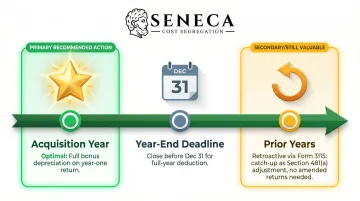
Year-end timing advantage: Closing before December 31 allows an entire year of accelerated depreciation to be claimed even if the purchase occurs in the final days of December.
The Study Process
An engineering team reviews:
- Construction documents and blueprints
- Closing statements and purchase agreements
- Appraisals and renovation invoices
- Physical or photo-documented site inspection
They produce a detailed report mapping every component to its MACRS class with supporting schedules your CPA uses to file Form 4562. CCSP-certified firms with engineering-based methodology — like Seneca Cost Segregation — typically deliver completed studies within 2–4 weeks, and the best include AuditDefense coverage so your deductions are protected if the IRS questions them.
Retroactive Studies Still Work
The study process above applies to new acquisitions — but cost segregation isn't limited to recent purchases. Retroactive studies on properties owned for years are equally valuable, particularly for investors who used standard depreciation from the start and are now optimizing their portfolios. Form 3115 allows catch-up depreciation as a single-year Section 481(a) adjustment without amending prior returns.
Common Mistakes That Cost High-Income Investors
Overly Aggressive Reclassification Claims
Some discount providers promise 40%+ reclassification rates on residential properties to win business. Rates above 25% on standard residential rentals are uncommon and invite scrutiny.
The IRS Cost Segregation Audit Techniques Guide specifically requires engineering-based methodology with granular asset documentation. Thin studies that lack engineering backup, physical inspection records, and source invoices are audit bait.
A disallowed deduction triggers back taxes, interest, and penalties that easily exceed the cost of a proper study.
Ignoring State Tax Decoupling
Several states, including California, do not conform to federal bonus depreciation rules. An investor can claim a large federal bonus depreciation deduction and receive a much smaller one at the state level — or none at all.
Before commissioning a study, model both scenarios:
- Confirm your state's conformity status with a CPA familiar with state tax law
- Run federal and state projections side by side
- Factor the state shortfall into your after-tax ROI calculation
Failing to Plan for Depreciation Recapture at Sale
Investors who accelerate large deductions without planning for eventual sale face a steep recapture tax bill. The solution:
- Plan 1031 exchange strategies in advance
- Model after-tax sale economics before acquisition decisions
- Work with a CPA who understands both the acceleration strategy and the exit
Frequently Asked Questions
Can you do a cost segregation study on a condo?
Yes. Cost segregation applies to condo units, focusing on components within the unit—flooring, fixtures, cabinetry, appliances, and improvements. Since you don't own the building structure or site improvements, the reclassifiable portion is limited but not eliminated, typically 25-33% of depreciable basis.
What is the minimum property value for cost segregation to make sense?
Most tax professionals cite $300,000–$500,000 in property value as the general threshold where study costs are justified by tax savings. ROI improves significantly as property value increases, often reaching 15-20x at higher values.
Can a high-income W-2 earner use cost segregation losses without REPS?
W-2 earners above $150,000 MAGI cannot use passive rental losses against wages unless they qualify for REPS, participate materially in a short-term rental, or have passive income from other sources to offset. Without one of these pathways, losses are suspended until sale.
What happens to accelerated depreciation deductions when I sell the rental property?
Depreciation recapture applies at sale. Section 1245 property is recaptured at ordinary income rates; Section 1250 property is taxed at up to 25%. A 1031 exchange is the most common strategy to defer this liability.
How much does a cost segregation study cost, and how long does it take?
Study fees typically range from $5,000 to $15,000, according to the Journal of Accountancy, depending on property type, value, and complexity. Most qualified engineering-based firms complete studies in 2–4 weeks from engagement to final report delivery.
Can I do a cost segregation study on a property I've already owned for several years?
Yes. Retroactive look-back studies are available for properties placed in service in prior years. Using Form 3115, you can claim catch-up depreciation as a Section 481(a) adjustment in the current year without amending prior returns.