Introduction
A single cost segregation study can generate over $171,000 in first-year deductions, or cost you far more in missed savings and IRS scrutiny if the provider gets it wrong. When executed by qualified engineers using IRS-compliant methodology, it's one of the most effective tax strategies in real estate. When performed by unqualified firms using template-based estimates, the consequences range from leaving money on the table to triggering audits.
The growing number of cost segregation firms, from boutique engineering specialists to Big Four accounting arms, makes provider selection a high-stakes decision for real estate investors.
The difference between a defensible, engineering-based study and a generic percentage-based estimate can mean tens of thousands of dollars in lost savings or, worse, audit exposure.
This guide ranks and compares the top cost segregation providers in 2026, covers the criteria used to evaluate them, and explains what to look for before signing any engagement.
TL;DR
- Cost segregation accelerates depreciation on commercial and residential investment properties, generating significant front-loaded tax deductions in year one
- Engineering-based studies with CCSP-certified professionals are the IRS-preferred approach and hold up better under audit
- Evaluate providers on ASCSP certification, audit defense policy, turnaround time, pricing structure, and verified client track record
- Seneca Cost Segregation ranks #1 for investors: CCSP-certified, engineering-based, AuditDefense with money-back guarantee, 95% referral rate
- National firms like KBKG and ETS suit enterprise clients; boutique specialists like Seneca deliver faster turnarounds and direct service for individual investors
What Is Cost Segregation and Why Your Provider Choice Matters
Cost segregation is an IRS-recognized tax strategy that reclassifies components of a real property from 39-year (or 27.5-year) depreciation schedules into 5-, 7-, or 15-year asset classes. This acceleration of deductions improves near-term cash flow and allows investors to reinvest capital faster.
Not all studies are equal. The IRS Cost Segregation Audit Technique Guide explicitly prefers "Detailed Engineering" approaches and warns that "rule-of-thumb" methods lack sufficient support and should be viewed with caution. Non-engineering studies routinely miss reclassifiable value and won't hold up under IRS scrutiny.
The providers below were evaluated on criteria that matter most to real estate investors seeking maximum, defensible tax savings:
- Methodology: Engineering-based vs. rule-of-thumb approaches
- Credentials: Licensed engineers, CCSP designations, ASCSP membership
- Audit defense: Whether studies include formal IRS audit protection
- Turnaround time: Speed from engagement to delivered report
- Value: Cost relative to average first-year deductions achieved
Top Cost Segregation Providers in 2026 (Ranked & Compared)
Providers are ranked based on ASCSP certifications, engineering methodology, audit defense, client outcomes, turnaround time, and investor-centric service, not just firm size or brand name.
| Provider | CCSPs on Staff | Engineering-Based | Audit Defense | Turnaround | Fee Structure | Best For |
|---|---|---|---|---|---|---|
| Seneca Cost Segregation | Yes (CCSP-certified team) | Yes | Money-back guarantee | 2–4 weeks | Flat-rate (competitive) | All investor types; all 50 states |
| KBKG | 10+ | Yes | Not specified | Not specified | $$–$$$ | CPAs; mid-market to large commercial |
| Engineered Tax Services (ETS) | Licensed engineers on every study | Yes | Strong IRS audit track record | Not specified | $$$–$$$$ | Large commercial; institutional |
| Source Advisors | 6 | Yes | Not specified | Not specified | $$ | Middle-market; limited national offices |
| MS Consultants | 2 | Yes | Not specified | Not specified | $$ | Midwest and Northeast investors |
Seneca Cost Segregation
Seneca is a veteran-owned, engineering-based cost segregation firm with over 12 years of experience and more than 10,200 properties assessed across all 50 states. Co-founders Paul Spies (licensed contractor, principal broker, and real estate investor) and Dylan Scandalios (a multi-family investor in the Pacific Northwest) built the firm around the same tax strategies they've used personally since 2018.
Key differentiators:
- CCSP-certified team (ASCSP member)
- Proprietary in-house technology built by engineers and tested for IRS compliance
- AuditDefense with money-back guarantee
- Average first-year deduction of $171,243
- 95% client referral rate
- Studies delivered within 2–4 weeks
- Complimentary tax assessments beyond cost segregation
| Category | Details |
|---|---|
| Certifications / Credentials | ASCSP member; CCSP designation; licensed professional engineers on staff; licensed contractor and principal broker |
| Services Offered | Engineering-based cost segregation studies, bonus depreciation analysis, look-back studies, complimentary tax strategy assessments |
| Best For / Pricing | Real estate investors of all sizes (single-family, multi-family, commercial, STR/LTR); competitive flat-rate pricing; all 50 states |

KBKG
Founded in 1999 and headquartered in Pasadena, CA, KBKG operates seven offices nationally and is one of the most credentialed cost segregation firms in the country. The firm employs 10+ CCSPs on staff, including past and current ASCSP presidents.
Key differentiators:
- 10+ CCSPs, including current and past ASCSP presidents
- Proprietary DIY software (Cost Seg Pro) for smaller properties
- Stacks multiple tax incentives: R&D credits, 179D, and 45L
- Seven brick-and-mortar offices for on-site accessibility
Best for CPAs, institutional investors, and mid-to-large commercial portfolios. Pricing reflects the firm's enterprise positioning.
| Category | Details |
|---|---|
| Certifications / Credentials | 10+ CCSPs; includes ASCSP past and current presidents; nationally recognized engineering expertise |
| Services Offered | Cost segregation, R&D tax credits, 179D deductions, solar cost segregation, proprietary DIY software |
| Best For / Pricing | CPAs, mid-market to large commercial investors; higher price point ($$–$$$); 7 brick-and-mortar offices |
Engineered Tax Services (ETS)
ETS is one of the largest specialty tax consulting firms in the U.S., operating for 25+ years and positioning itself as the only licensed engineering firm exclusively focused on tax strategies. The firm serves a broad range of property types and business owners nationwide.
Differentiators:
- Full engineering-based methodology with licensed engineers on every study
- Strong IRS audit track record
- Broad service stack including 179D, 45L, R&D credits, and commercial insurance
The firm's scale and brand recognition make it a credible choice for larger or more complex portfolios, though individual investors may find the experience less personalized.
| Category | Details |
|---|---|
| Certifications / Credentials | Licensed engineering firm; 25+ years specialty tax focus; IRS-trusted audit standing |
| Services Offered | Cost segregation, R&D credits, 179D, 45L, 1031 exchange services, commercial insurance, grants |
| Best For / Pricing | Large commercial portfolios, institutional owners, complex multi-property clients; premium pricing ($$$–$$$$) |
Source Advisors
Source Advisors is an established specialty tax firm founded in 1983 and headquartered in Fort Worth, TX. The firm has six CCSPs on staff and a strong presence in the middle-market tax advisory community, offering engineering-based cost segregation alongside R&D and 179D services.
The credentials and 40-year track record are genuine strengths. That said, single-office operations can limit on-site responsiveness, and its private equity-owned structure may reduce the transparency that individual investors expect from an advisory relationship.
| Category | Details |
|---|---|
| Certifications / Credentials | 6 CCSPs on staff; 40+ years in tax advisory; engineering-based methodology |
| Services Offered | Cost segregation, R&D tax credits, 179D deductions |
| Best For / Pricing | Middle-market businesses and investors; limited national office presence; mid-range pricing ($$) |
MS Consultants
MS Consultants is a specialized, engineering-first cost segregation firm founded in 1996 and based in the Midwest, with a strong track record particularly in the Northeast and among investors who prioritize technical depth over brand recognition.
The firm has two CCSPs on staff and takes an engineering-led approach. However, limited client-facing technology and sparse publicly available review data make it harder to assess service quality relative to peers. Requesting sample reports and reference checks before engaging allows investors to assess service quality relative to peers.
| Category | Details |
|---|---|
| Certifications / Credentials | 2 CCSPs on staff; engineering-based methodology; 28+ years in cost segregation |
| Services Offered | Cost segregation, fixed asset reviews, engineering-based tax advisory |
| Best For / Pricing | Investors in the Midwest and Northeast; no publicly available review scores; mid-range pricing ($$) |
How We Selected These Top Cost Segregation Providers
Providers were assessed based on publicly available data, industry credentials, client outcomes, and factors that directly impact a real estate investor's risk and return, not just firm size or marketing presence. Choosing the cheapest option without verifying methodology or audit support is one of the most expensive mistakes investors make.
ASCSP Certification and Engineering Methodology
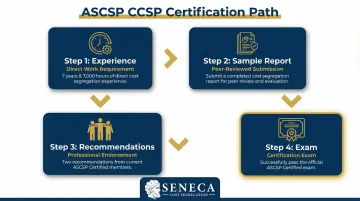
The American Society of Cost Segregation Professionals (ASCSP) is the industry's leading credentialing body. Certified Cost Segregation Professionals (CCSPs) must meet rigorous standards:
- Minimum 7 years and 7,000 hours of direct cost segregation experience
- Submission of a sample cost segregation report for peer review
- Recommendations from two existing Certified members
- Passing the ASCSP Certified exam
Engineering-based studies using the IRS's preferred "Detailed Engineering Approach" capture the most depreciable value that can be reclassified and are most defensible under audit. The IRS Cost Segregation Audit Technique Guide explicitly warns that "rule of thumb" approaches using fixed percentages or industry averages should be viewed with caution.
Audit Defense and IRS Compliance
IRS scrutiny of cost segregation studies has increased. A clear audit defense policy is a standard indicator of provider quality. Key documentation standards include:
- Documentation standards that meet all 13 principal elements of a quality study outlined in the IRS ATG
- Asset-by-asset classifications with engineering take-offs
- Citations to IRS guidance and proper Form 3115 filing for method changes
- Reconciliation of allocated costs to actual property basis
Providers without audit support expose clients to real penalties. Under Chief Counsel Advice (CCA) 201805001, an engineer who mischaracterized property faced §6701 penalties ($1,000 per individual return and $10,000 per corporate return) for aiding and abetting understatements.
Client Track Record and Referral Rate
Verifiable client reviews, referral rates, and case study data demonstrate consistent service quality. Providers with review scores above 4.0 who can document average first-year deduction outcomes normalized for property type and value demonstrate consistent service quality.
A provider's track record of completed studies (measured in thousands, not hundreds) demonstrates experience across varied property types and market conditions.
Turnaround Time and Operational Transparency
For investors managing active portfolios, turnaround time directly affects reinvestment speed and tax filing deadlines. According to the Journal of Accountancy, industry standard is 4–8 weeks. Top performers deliver in 2–4 weeks.
Clear communication on fees, deliverables, and timelines distinguishes providers who treat investor deadlines as a priority, not an afterthought.
Pricing Structure
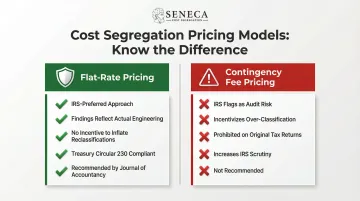
The IRS Audit Techniques Guide instructs examiners to "closely scrutinize" studies performed on contingency fees, noting they create an incentive to inappropriately maximize reclassifications. Treasury Circular 230 §10.27 prohibits practitioners from charging contingent fees for services rendered in connection with original tax returns.
Flat-rate or clearly scoped fee structures are the right standard, as they ensure findings reflect actual engineering analysis, not a provider's financial upside. The Journal of Accountancy cites typical fees of $10,000 to $25,000 for well-executed engineering studies, with costs varying based on property size and complexity.
| Fee Type | IRS Stance | Regulatory Note | Characteristics |
|---|---|---|---|
| Flat-rate / clearly scoped | Preferred standard | Not prohibited under Treasury Circular 230 §10.27 | Findings reflect actual engineering analysis, not provider financial upside |
| Contingency-based | "Closely scrutinized" per IRS ATG; creates incentive to inappropriately maximize reclassifications | Prohibited by Treasury Circular 230 §10.27 for services on original tax returns | Creates financial incentive to inflate reclassifications |
Conclusion
Choosing a cost segregation provider is not just a cost decision; it is a risk and quality decision. The right firm will use engineering-based methodology, maintain IRS-compliant documentation, and stand behind their work with audit defense.
Key criteria for assessing each provider before signing an engagement include:
- Credentials: CCSP certification and licensed engineers on staff
- Track record: Client referral rates and number of completed studies
- Turnaround: Confirmed timeline (industry standard is 2–4 weeks)
- Fee structure: Fixed-fee vs. contingency, and what's included
- Documentation: Sample reports are available to verify coverage of all 9 IRS-required elements
Firms that check all five boxes are rare. Seneca Cost Segregation has 12+ years of engineering-based experience, a money-back AuditDefense guarantee, and an average first-year deduction of $171,243 across 10,200+ studies. A complimentary property assessment is available to determine exactly how much accelerated depreciation a property qualifies for.
Frequently Asked Questions
What is the average cost of a cost segregation study?
Study fees typically vary based on property type, size, and complexity. According to the Journal of Accountancy, a well-executed engineering study commonly costs between $10,000 and $25,000 for most commercial and residential investment properties. Flat-rate pricing is preferable to percentage-based fees, which the IRS flags as audit risk factors.
Who to hire for a cost segregation study?
Firms with at least one CCSP-certified professional, an engineering-based methodology, and a clear audit defense policy meet the baseline criteria for IRS-compliant cost segregation work. CPAs can file the results on your tax return but are generally not qualified to perform the study itself. Providers following the IRS's "Detailed Engineering Approach" outlined in Publication 5653 produce IRS-compliant studies.
Does the IRS accept cost segregation studies?
Yes, the IRS accepts cost segregation studies when they are performed using the Detailed Engineering Approach and properly documented. The IRS Audit Techniques Guide for cost segregation outlines the accepted methodology and requires 13 principal study elements and 9 specific report components for quality compliance.
Is cost segregation worth it?
Cost segregation is generally worth it for properties valued at $500,000 or more where the owner has taxable income to offset. The front-loaded deductions improve near-term cash flow and accelerate reinvestment. A property with $171,243 in first-year deductions at a 37% tax rate generates roughly $63,360 in savings, typically returning 10–25x the study cost.
What are the best properties for cost segregation?
Cost segregation works best on commercial properties, multi-family buildings, short-term rentals, and industrial properties with high concentrations of personal property and land improvements. Recently purchased, newly constructed, or remodeled properties are ideal candidates because they maximize the time value of accelerated deductions.
Can you do a cost segregation study on a commercial property?
Yes, commercial properties are among the most common and highest-value candidates for cost segregation. Office buildings, retail spaces, warehouses, and mixed-use properties all benefit from reclassifying components — flooring, lighting, HVAC systems, and site improvements — into shorter depreciation lives of 5, 7, or 15 years instead of the standard 39-year schedule.