Introduction
With a hard federal deadline approaching, commercial property owners and real estate investors face a shrinking window to act on two high-impact tax strategies: cost segregation and Section 179D energy-efficiency deductions. Used together, they accelerate depreciation and generate substantial first-year deductions on the same property, with no overlap between the two.
The urgency is real: the One Big Beautiful Bill Act (OBBBA, Public Law 119-21), signed July 4, 2025, set a hard deadline for Section 179D—projects must commence before June 30, 2026 to qualify. That makes the choice of a qualified, engineering-based provider more time-sensitive than ever.
This guide ranks 10 leading U.S. providers evaluated on:
- ASCSP/CCSP credentials and engineering rigor
- Section 179D certification capability
- Audit defense strength and IRS compliance track record
- Turnaround time and delivery consistency
- Verified client outcomes and referral rates
TL;DR
- Section 179D offers up to $5.94/sq ft for energy-efficient buildings in 2026; cost segregation accelerates depreciation—stacking both maximizes first-year deductions
- CCSP certification and licensed PE staff for 179D studies are the baseline credentials to verify before hiring any provider
- Construction must commence by June 30, 2026 to qualify under the One Big Beautiful Bill Act (OBBBA) — deadlines are firm
- Seneca Cost Segregation offers CCSP-certified engineering, an AuditDefense money-back guarantee, 10,200+ completed studies, and 2–4 week turnaround across all 50 states
What Are Section 179D Cost Segregation Tax Services?
Cost segregation is an IRS-compliant engineering analysis that reclassifies building components into shorter depreciation lives (5, 7, or 15 years) to accelerate deductions. Section 179D is a complementary federal deduction for energy-efficient improvements (lighting, HVAC, building envelope) worth up to $5.94/sq ft in 2026.
Cost segregation targets short-lived personal property and land improvements, while 179D targets long-lived energy systems that are otherwise ineligible for accelerated depreciation. Together, they cover more of the building's cost basis than either strategy alone — with no overlap between the two.
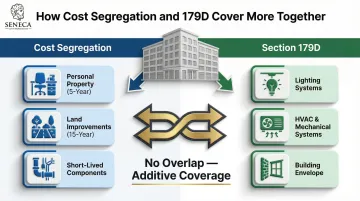
That combined coverage makes provider selection critical. Not all cost segregation firms can certify 179D studies — per IRS Form 7205 instructions, 179D certification requires a licensed professional engineer or contractor in the building's jurisdiction. When evaluating providers, confirm they offer:
- In-house licensed engineering staff (not outsourced)
- 179D certification capability in your property's state
- Experience delivering both studies as a single integrated engagement
Top 10 Section 179D Cost Segregation Tax Service Providers in the USA (2026)
Each firm below was evaluated on:
- ASCSP/CCSP certification and engineering-based methodology
- Section 179D certification capability
- Audit defense record and IRS-defensibility
- Nationwide reach and turnaround time
- Verified client outcomes
Seneca Cost Segregation
A veteran-owned firm co-founded by active real estate investors and engineers, Seneca delivers engineering-based cost segregation and 179D studies across all 50 states. With over 10,200 properties assessed and an average first-year deduction of $171,243, the firm stands out for founders who have personally used these strategies as active investors.
Key strengths include a CCSP-certified team, proprietary in-house technology built for IRS compliance, AuditDefense with a money-back guarantee, 2–4 week study turnaround, and a 95% client referral rate. One of the few firms founded by investors who use these strategies themselves.
| Services Offered | Engineering-based cost segregation, Section 179D studies, complimentary tax assessments, audit defense, all 50 states |
|---|---|
| Key Differentiator | Proprietary compliance technology, CCSP-certified, money-back AuditDefense guarantee, veteran-owned, founded by investors |
| Best For | Real estate investors, multi-family and commercial property owners, STR/LTR owners seeking fast, IRS-defensible studies |

KBKG
Founded in 1999 and headquartered in Pasadena, CA with 7+ offices nationally, KBKG is a specialist tax incentives firm with one of the largest teams of CCSPs in the country. The firm developed proprietary cost segregation software for smaller properties and maintains a strong ASCSP leadership presence.
Known for high ASCSP-certified professional concentration, robust audit defense, and the ability to stack 179D with cost segregation for commercial clients.
| Services Offered | Cost segregation, Section 179D, R&D tax credit, 45L, transfer pricing, DIY software tool |
|---|---|
| Key Differentiator | Highest number of CCSPs nationally, ASCSP leadership, proprietary client-facing cost segregation software |
| Best For | CPAs, mid-to-large commercial property owners, and enterprises requiring deep certification bench depth |
CSSI Services
Based in Baton Rouge, LA, CSSI Services has completed over 55,000 cost segregation studies and offers both Section 179D analysis and R&D tax credits. One of the highest-volume specialist firms in the U.S.
Differentiates with a free no-cost analysis upfront and broad property type coverage—from single-family rentals to casinos. That volume of completed work produces studies with consistent documentation and established IRS-defensible templates across property types.
| Services Offered | Cost segregation, Section 179D, R&D tax credits, free no-cost qualification analysis |
|---|---|
| Key Differentiator | 55,000+ studies completed, wide property type coverage |
| Best For | High-volume investors, CPAs with multiple client properties, and STR/vacation rental owners |
Capstan Tax Strategies
Dresher, PA-based Capstan Tax Strategies offers integrated engineering-based cost segregation and 179D energy deduction services with a strong emphasis on CPA partnerships. The firm runs Capstan University, a CPE training program for tax professionals.
Known for its integrated approach to stacking 179D with cost segregation—specifically highlighting that 179D permits immediate write-off of long-lived energy assets not eligible for segregation. Provides licensed PE-led inspections in the building's jurisdiction.
| Services Offered | Cost segregation, Section 179D, R&D tax credits, tangible property analysis, energy-efficient tax incentives |
|---|---|
| Key Differentiator | Integrated 179D + cost seg strategy, CPA-focused training platform, licensed PE-led on-site inspections |
| Best For | CPA firms seeking a white-label or referral partner, commercial property owners with energy-efficiency upgrades |
Cherry Bekaert
Cherry Bekaert is a national CPA and advisory firm with a dedicated Tax Credits & Incentives team that provides both cost segregation analyses and Section 179D studies, serving clients across real estate, construction, healthcare, and government contracting.
Stands out for having CPAs on staff who can directly prepare returns and file forms alongside the cost segregation/179D study, offering statistical sample studies for portfolios, and maintaining in-house energy modeling capability to protect sensitive project data.
| Services Offered | Cost segregation, Section 179D, energy tax credits, R&D credits, full tax advisory |
|---|---|
| Key Differentiator | CPAs on staff for return preparation, in-house energy modeling team, statistical sample studies for portfolios |
| Best For | Institutional investors, healthcare organizations, and government-adjacent entities needing 179D designer allocations |
Source Advisors
Fort Worth, TX-based Source Advisors (est. 1983) brings over 40 years of tax incentive experience and a team of CCSPs, offering cost segregation, Section 179D, and R&D tax credit services with a focus on the middle market.
Strong CCSP bench and decades of engineering experience make them a credible option for middle-market CPAs and commercial developers.
| Services Offered | Cost segregation, Section 179D, R&D tax credits |
|---|---|
| Key Differentiator | 40+ years in business, experienced CCSP team, strong middle-market CPA relationships |
| Best For | Middle-market businesses, CPAs seeking an experienced referral partner for both 179D and cost seg |
Deloitte
One of the Big Four accounting firms, Deloitte offers cost segregation and 179D advisory services as part of a broad tax and real estate practice, with offices spanning every major U.S. metro and a global client base.
Best suited for large institutional clients and Fortune 500 companies with complex multi-property portfolios requiring integrated tax, audit, and advisory services. Cost segregation is one component within a broader real estate tax practice rather than a standalone service line.
| Services Offered | Cost segregation, Section 179D advisory, full tax and audit advisory suite |
|---|---|
| Key Differentiator | Big Four brand, global scale, suitable for complex multi-entity and institutional structures |
| Best For | Fortune 500s, large institutional real estate investors, and clients with cross-border tax complexity |
CohnReznick
New York-based CohnReznick (est. 1919) is well known for its real estate and construction industry focus, offering cost segregation within its broader tax and advisory services to developers, builders, and property investors nationwide.
Their concentration in real estate and construction means engineers and tax advisors regularly work on projects where construction cost documentation is already available, streamlining the cost segregation analysis.
| Services Offered | Cost segregation, audit, tax advisory, real estate consulting |
|---|---|
| Key Differentiator | Deep real estate and construction industry specialization, strong developer client base |
| Best For | Real estate developers and construction firms seeking a full-service advisory partner |
MS Consultants
South Bend, IN-based MS Consultants (est. 1996) takes an engineering-first approach to cost segregation with a long track record in the Midwest and Northeast, offering studies backed by licensed engineers. The firm prioritizes technical rigor over client-facing technology, which suits investors who want detailed engineering documentation but don't require a digital portal or real-time tracking.
| Services Offered | Cost segregation, engineering-based tax advisory |
|---|---|
| Key Differentiator | Engineering-first methodology, nearly 30 years of cost segregation experience, Midwest/Northeast presence |
| Best For | Commercial property owners in the Midwest and Northeast seeking a technically focused specialist |
Baker Tilly / Moss Adams
The 2025 merger of Baker Tilly (Chicago) and Moss Adams (Seattle) created a combined firm with 50+ U.S. offices and a strong national footprint for cost segregation and tax advisory, with particular strength on the West Coast through the legacy Moss Adams network.
Offers a full-service tax and advisory approach to cost segregation. Best for clients who want cost segregation bundled with broader CPA services.
| Services Offered | Cost segregation, tax advisory, audit, business consulting |
|---|---|
| Key Differentiator | 50+ national offices post-merger, strong West Coast reach via Moss Adams, full-service CPA integration |
| Best For | Mid-to-large businesses seeking a regional CPA firm that can bundle cost segregation within a broader tax engagement |
How We Chose the Best Providers
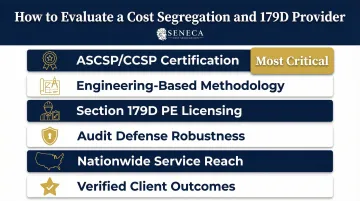
We assessed providers across six criteria:
- ASCSP/CCSP certification depth — Most heavily weighted, as it reflects IRS-mirrored quality standards set by the American Society of Cost Segregation Professionals
- Engineering-based methodology — Versus online-form or desktop-only approaches
- Section 179D licensing capability — Must have licensed PE or contractor in-jurisdiction
- Audit defense robustness — Guarantees, experience, and IRS scrutiny withstanding
- Nationwide service reach — Ability to serve all 50 states with consistent quality
- Verified client outcomes — Review scores, referral rates, average deductions
Understanding what separates strong providers from weak ones also means recognizing where buyers go wrong.
Common Selection Mistakes
- Choosing the cheapest provider without checking for CCSP credentials
- Selecting a firm that only handles cost segregation but lacks licensed PE staff for 179D certification
- Accepting inflated proposal estimates that don't hold up under IRS scrutiny
The IRS Cost Segregation Audit Techniques Guide warns that contingency-fee arrangements "create the incentive to maximize the amount of costs attributed to § 1245 property." Examiners are directed to "closely scrutinize studies performed on contingency fees." A poorly constructed study can expose you to more in audit liability than you ever saved on the provider's fee.
2026-Specific Urgency Factor
Given the June 30, 2026 commencement deadline for Section 179D under OBBBA, providers must be able to complete certifications within a tight window. Turnaround time and staffing capacity were also factored into the rankings.
Conclusion
For real estate investors and commercial property owners in 2026, stacking Section 179D with cost segregation represents one of the most powerful tax strategies—but only when executed by a certified, engineering-based provider with the credentials and audit defense to back their work.
Go beyond price comparisons. Before signing any engagement agreement, confirm:
- CCSP credentials from the American Society of Cost Segregation Professionals
- Licensed professional engineers conducting 179D inspections
- Explicit audit defense protocols and what they cover
If you want to size up your savings potential before the 2026 deadline, Seneca Cost Segregation offers a free assessment to get you started. Studies are completed in 2–4 weeks, the average first-year deduction is $171,243, and every engagement includes a money-back AuditDefense guarantee.
Frequently Asked Questions
What is the difference between a Section 179D deduction and a cost segregation study?
Cost segregation accelerates depreciation by reclassifying building components into shorter tax lives (5–15 years), while Section 179D provides an immediate deduction (up to $5.94/sq ft in 2026) specifically for energy-efficient improvements to lighting, HVAC, and building envelope. Both reduce taxable income but target different building components.
Can you claim both Section 179D and cost segregation on the same property?
Yes, both can be claimed simultaneously on the same property without overlap. Cost segregation targets short-lived personal property and land improvements, while 179D targets long-lived energy systems that are not eligible for accelerated depreciation. The two strategies are additive, not duplicative.
Is Section 179D still available in 2026?
Section 179D remains available in 2026 but the One Big Beautiful Bill (OBBBA) enacted a sunset provision—projects must commence construction prior to June 30, 2026 to qualify for the deduction. Missing that deadline permanently forfeits the deduction, so engage a qualified provider before the cutoff.
What credentials should I look for when hiring a cost segregation and 179D provider?
Look for ASCSP membership and the Certified Cost Segregation Professional (CCSP) designation as the industry standard for cost segregation. For 179D studies, certification must be performed by a licensed professional engineer or contractor in the building's jurisdiction. Firms lacking these credentials expose clients to IRS audit risk.
Who qualifies for the Section 179D deduction?
Building owners who construct or renovate energy-efficient commercial properties qualify directly, provided the improvements reduce energy costs by at least 25% versus a reference building. Architects, engineers, and designers who create qualifying systems for tax-exempt or government-owned buildings can receive an allocated deduction.
How much does a combined cost segregation and Section 179D study typically cost?
Cost segregation studies typically range from a few thousand dollars to tens of thousands for large commercial properties; 179D certifications add an incremental cost on top. Always request itemized proposals and avoid contingency-fee arrangements, which the IRS may classify as a reportable transaction under Circular 230.