Introduction
Commercial real estate stands apart from stocks, bonds, and most traditional investments in one fundamental way: the U.S. tax code rewards ownership. Unlike passive equity holdings, CRE investors can simultaneously offset income, defer capital gains, and accelerate deductions—legally reducing taxable income while building wealth through appreciating assets.
Most investors know tax benefits exist. Fewer understand which ones apply to their situation, how to stack multiple strategies for maximum impact, or how much cash flow they're leaving on the table by not acting. Investors who dramatically improve after-tax returns aren't using different rules—they're using tools like cost segregation, 1031 exchanges, and bonus depreciation in sequence, timed to each phase of ownership.
TL;DR
- Depreciation deductions (including cost segregation) convert 20–40% of property costs into immediate deductions
- 100% bonus depreciation is now permanent for property acquired after January 19, 2025
- 1031 exchanges defer capital gains and depreciation recapture indefinitely
- QBI deduction allows eligible investors to deduct up to 20% of qualifying income
- Stacking these strategies is what separates investors who maximize after-tax cash flow from those who leave money on the table
What Are Commercial Real Estate Tax Benefits?
Commercial real estate tax benefits are legal provisions within the U.S. tax code that allow owners of income-producing property to reduce taxable income, defer taxes, or eliminate them entirely—without selling the asset.
These benefits apply across all commercial property types: office, retail, industrial, multifamily, and mixed-use. Individual investors, LLCs, partnerships, S corporations, and C corporations can all claim these deductions, though key distinctions apply—particularly around passive activity rules and real estate professional status.
How the System Works
Each tax benefit operates independently, but the real gains come from combining them as part of a coordinated strategy. Each tool targets a different moment in the investment lifecycle:
- Depreciation reduces current-year taxable income while you hold the property
- Operating expense deductions lower ordinary income on an ongoing annual basis
- 1031 exchanges defer capital gains taxes when you sell and reinvest
- Step-up in basis at death can eliminate deferred taxes entirely for heirs

Used together, these provisions can dramatically shift your effective tax rate on real estate income — which is why investors who understand the full toolkit consistently outperform those relying on a single strategy.
Key Tax Benefits of Commercial Real Estate Investing
The benefits below are ordered by impact and practicality—from highest-leverage strategies to essential deductions most investors use but often underutilize.
Depreciation Deductions and Cost Segregation
The IRS allows commercial properties to be depreciated over 39 years (27.5 years for residential rental property). For a $2,000,000 property (excluding land), this creates an annual straight-line deduction of approximately $51,282.
Cost segregation accelerates this timeline by decades. An engineering-based cost segregation study reclassifies building components—flooring, electrical systems, fixtures, land improvements—into 5-, 7-, or 15-year depreciation schedules instead of 39 years. This front-loads deductions into earlier years when they deliver maximum cash flow impact.
Across over 10,200 properties, Seneca Cost Segregation's engineering-based studies have delivered an average first-year deduction of $171,243—real tax savings generated without any additional cash outlay.
How Bonus Depreciation Changed the Game
Under the Tax Cuts and Jobs Act (TCJA), bonus depreciation was scheduled to phase down after 2022. But the One Big Beautiful Bill (OBBB) and IRS Notice 2026-11 restored 100% bonus depreciation permanently for qualified property acquired after January 19, 2025.
Bonus Depreciation Schedule:
| Tax Year / Acquisition Date | Bonus Depreciation % |
|---|---|
| 2018–2022 | 100% |
| 2023 | 80% |
| 2024 | 60% |
| Acquired on/before Jan 19, 2025 | 40% |
| Acquired after Jan 19, 2025 | 100% (permanent) |
Qualifying short-life assets identified through cost segregation can now be expensed at 100% in Year 1, creating substantial front-loaded deductions that offset active or passive income depending on investor classification.
Why This Advantage Matters
Generating a large non-cash deduction in Year 1 reduces taxable income from real cash income—effectively lowering the real cost of owning the property. Unlike most deductions, depreciation requires no cash outlay. It's a paper loss offsetting actual rental income.
KPIs Impacted:
- Effective tax rate
- After-tax cash flow
- Return on equity
- Time-to-reinvestment (how quickly freed-up cash enables the next acquisition)
Understanding which properties benefit most helps investors prioritize when to commission a study.
When This Advantage Matters Most:
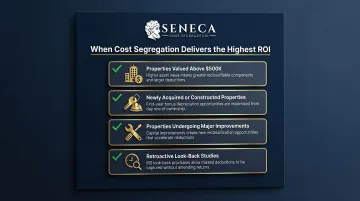
Cost segregation delivers highest ROI on:
- Properties valued above $500K
- Newly acquired or newly constructed properties
- Properties undergoing major improvements
- Retroactive look-back studies on properties held for multiple years without a prior cost segregation analysis