
Introduction
Commercial investment property stands as a foundational pillar of wealth-building through real estate. These properties house businesses, generate rental income, and make up a significant portion of institutional portfolios globally. Heading into 2025, institutional investors targeted an average 10.7% allocation to real estate, underscoring its importance as an alternative asset class.
Many investors are drawn to commercial real estate for its income potential, yet the mechanics behind how it actually works remain widely misunderstood, from acquisition to return generation. That gap leads to missed opportunities and property decisions that don't hold up under scrutiny.
This guide breaks down what commercial investment property is, how it works step-by-step, the main property types, and what investors need to know to evaluate opportunities with confidence.
TL;DR
- Commercial investment property is real estate acquired to generate profit through rental income, appreciation, or both
- Properties span office, retail, industrial, multifamily, and specialty types, each with distinct risk/return profiles
- Successful deals follow a clear cycle: acquire, generate income, build value, then realize returns, with each stage having its own levers to pull
- Key metrics like NOI, cap rate, and cash-on-cash return determine whether a deal makes financial sense
- Depreciation and cost segregation can convert 20–40% of property cost into immediate tax deductions, directly improving cash flow
What Is Commercial Investment Property?
Commercial investment property is any real estate acquired with the primary intent to generate income or profit, rather than for personal residential use. This includes properties leased to businesses as well as multifamily residential buildings. Properties containing five or more dwelling units are classified as commercial multifamily real estate, not residential.
Businesses need physical space to operate, and investors who own that space earn consistent, contract-backed rental income in return. Commercial investment property is not a primary residence, vacation home, or personally occupied office. The term "commercial" doesn't mean only retail storefronts. It covers a broad spectrum of property types from warehouses to apartment complexes.
Unlike residential homes valued through comparable sales, commercial properties are valued based on the income they generate. The Income Approach converts expected future Net Operating Income (NOI) into present value through direct capitalization. The fundamental formula is: Value = NOI ÷ Capitalization Rate.
This means a property's income directly drives its market value, giving investors the ability to "force" appreciation by improving NOI through better management and leasing decisions.
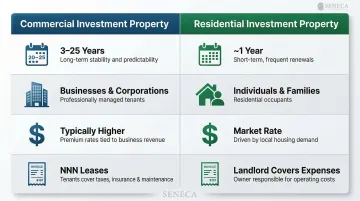
Commercial vs. Residential Investment: Key Differences
| Factor | Commercial | Residential |
|---|---|---|
| Lease length | 3–25 years | ~1 year |
| Tenant type | Businesses | Individuals |
| Rent level | Typically higher | Market rate |
| Cost structure | Triple-net (NNN) leases shift operating costs to tenants | Landlord covers most expenses |
How Does Commercial Investment Property Work?
Commercial investment property operates through a defined cycle, from acquisition through income generation, active management, and ultimately, return realization. Understanding each stage separates successful investors from those who underperform.
Acquisition and Financing
Step 1: Property Identification and Due Diligence
The investment process begins with identifying a target property, conducting due diligence (physical inspection, lease review, market analysis), and securing financing.
Step 2: Financing
Commercial mortgages typically require 20–30% down payments, with federal guidelines establishing Supervisory Loan-to-Value limits of 80% for construction and 85% for improved property.
Commercial Financing Requirements:
| Requirement | Threshold |
|---|---|
| Down Payment | 20–30% |
| LTV Limit (Construction) | 80% |
| LTV Limit (Improved Property) | 85% |
| DSCR Minimum | 1.20x–1.25x |
Lenders assess both the investor's creditworthiness and the property's income potential. Debt Service Coverage Ratio (DSCR) minimums of 1.20x to 1.25x ensure the property generates 20–25% more income than its mortgage obligations.
Step 3: Pre-Acquisition Income Evaluation
Commercial properties are evaluated using income-based valuation methods before acquisition, so investors must understand projected NOI and cap rates before committing capital.
Income Generation
The core mechanics are direct: tenants sign leases and pay rent, which flows to the owner as gross income. After deducting operating expenses (maintenance, insurance, taxes, management fees), the remainder is Net Operating Income (NOI).
Lease Structure Variations:
- Gross Lease: Owner pays all operating expenses; tenant pays flat rent
- Modified Gross Lease: Expenses divided between landlord and tenant, often using a "base year" structure
- Triple-Net Lease (NNN): Tenant pays base rent plus all operating costs (taxes, insurance, maintenance)
NNN leases are especially popular for their passive income characteristics and predictable cash flow.
Average Lease Lengths by Property Type:
| Property Type | Average Lease Term | Key Driver |
|---|---|---|
| Office (Class A) | 107 months | High tenant improvement costs |
| Industrial (Big Box) | 98 months | Supply chain security needs |
| Retail | 96 months | Smaller footprint demand |
| Office (Non-Prime) | 86 months | Tenant flexibility preference |
Value Management
Investors actively grow property value during the hold period by:
- Raising rents to market rates
- Reducing vacancies through better tenant management
- Improving the tenant mix
- Completing physical improvements
All of these actions increase NOI and therefore increase the property's appraised value under the Income Approach.
Tax strategy plays an equally important role. Cost segregation studies allow commercial property owners to accelerate depreciation deductions by reclassifying building components from 39-year real property into 5-, 7-, and 15-year categories, front-loading tax savings that can be reinvested into the property or used to fund the next acquisition.
Returns and Exit
Investors realize returns through:
- Ongoing cash flow: Monthly or quarterly distributions from NOI after debt service
- Property appreciation: Value growth over the hold period driven by NOI increases and cap rate compression
- Final sale or 1031 exchange: A Section 1031 exchange allows investors to defer capital gains taxes by rolling proceeds into a like-kind property
The most durable returns come from stacking advantages at each stage: buying at the right basis, structuring debt conservatively, maintaining strong occupancy, and optimizing tax position throughout the hold period.

Types of Commercial Investment Properties
Each commercial property type has a distinct risk profile, tenant type, lease structure, and income dynamic. Choosing the right type depends on the investor's goals, capital, and risk tolerance.
Property Type Snapshot:
| Property Type | Vacancy Rate | Notable Metric | Market Status |
|---|---|---|---|
| Office (Class A) | 20.8% (Q1 2025) | 107-month avg lease | Remote work pressure on demand |
| Retail (Grocery-anchored) | 4.0% | 4.4% rent premium over non-anchored | Strong anchor-driven traffic |
| Industrial | 6.7%–7.4% | 58.2M sq. ft. net absorption Q4 2025 | 3PL providers drive 35% of leasing |
| Multifamily (5+ units) | — | 1.0% rent growth late 2024 | Absorbing historic new supply |
| Special Purpose (Self-storage) | — | Street rents fell >10% in 2024 | Sharp correction in 2024 |
Office Properties
Office properties range from small professional suites to large multi-tenant high-rises and medical office buildings. They tend to offer longer leases and business tenants, but may require significant tenant improvement allowances.
Prime Class A buildings secure average lease terms of 107 months, while remote work trends continue to pressure demand. National vacancy reached 20.8% in Q1 2025, widening the gap between Class A assets and older Class B/C buildings facing obsolescence.
Retail and Shopping Centers
Retail properties include strip malls, standalone stores, and regional centers anchored by consumer-facing businesses. Anchor tenants (especially grocery stores) stabilize cash flow across a center and create a "gravitational pull" for foot traffic. Grocery-anchored centers maintain a tight 4.0% vacancy rate and command a 4.4% rent premium over non-anchored centers (which sit at 6.3% vacancy). High-traffic, accessible locations are key to retail performance.
Industrial Properties
Industrial properties, including warehouses, distribution centers, and manufacturing facilities, are driven by e-commerce and logistics demand. Build-outs are simpler, ongoing capital needs are lower, and tenant stability tends to be strong. Third-party logistics (3PL) providers account for roughly 35% of leasing activity, pushing average big-box lease terms to 98 months. In Q4 2025, the U.S. industrial market recorded 58.2 million sq. ft. of net absorption, with vacancy rates between 6.7% and 7.4% depending on the source.
Multifamily Properties
Multifamily buildings with five or more units are classified as commercial real estate. Valued on NOI like other commercial assets, they tend to hold value better during downturns due to the essential nature of housing.
After apartment values peaked above 24% year-over-year growth in 2022, the sector is now absorbing historic new supply, with national asking rent growth easing to 1.0% by late 2024.
Special Purpose and Other Types
Specialty assets include self-storage, hospitality, medical office, mixed-use, and land. These assets can deliver strong returns, but each requires specific knowledge of the underlying business model or market. Self-storage faced a sharp correction in 2024 with street rents falling more than 10% for the second consecutive year, while medical office buildings remain resilient due to aging demographics.
Pros, Cons, and Key Metrics of Commercial Property Investment
Benefits Worth Knowing
Primary investor benefits include:
- Higher income potential than residential real estate
- Longer lease terms that reduce turnover and provide predictable cash flow
- Ability to force appreciation through NOI improvement
- Portfolio diversification beyond stocks and bonds
- Tax advantages including depreciation and cost segregation
For example, Seneca Cost Segregation clients average first-year deductions of $171,243 through engineering-based studies that reclassify property components into accelerated depreciation categories.

Risks to Evaluate
Key risks investors must manage:
- Market volatility and economic sensitivity (vacancies rise in downturns)
- Tenant default or turnover
- High upfront capital requirements (20–30% down payments)
- Illiquidity (commercial assets can't be sold quickly)
- Management intensity of larger properties with multiple tenants
Key Financial Metrics
Understanding these risks makes clear why investors rely on specific financial metrics — each one quantifies a different dimension of risk and return. Essential metrics include:
- NOI (Net Operating Income): Gross income minus operating expenses
- Cap Rate: NOI ÷ purchase price, a measure of current yield and relative risk
- Cash-on-Cash Return: Annual cash flow ÷ equity invested
- The 2% Rule: Monthly rent should equal at least 2% of purchase price (less commonly applied in CRE than residential, but useful as a quick screen)
Current cap rates show how these metrics differ across property types:
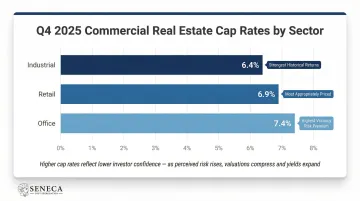
Cap Rate Benchmarks (Q4 2025):
| Sector | Average Cap Rate | Market Sentiment |
|---|---|---|
| Industrial | 6.4% | Strongest historical returns; stabilizing vacancy |
| Retail | 6.9% | Voted "most appropriately priced" by professionals |
| Office | 7.4% | Highest cap rates due to vacancy risk |
Cap rates reflect perceived risk directly: industrial's lower cap rate signals stronger investor confidence and durable demand, while office's elevated yield compensates for vacancy exposure. These four metrics each quantify a distinct dimension of risk and return across any target property.
Conclusion
Commercial investment property works through a repeatable cycle: acquire, generate income via leases, manage for value growth, and realize returns. Understanding each stage helps investors make better acquisition, financing, and operational decisions that build measurable wealth over time.
Informed investors don't just buy commercial property. They optimize it, from lease structure to tax strategy. Seneca Cost Segregation conducts engineering-based cost segregation studies that accelerate depreciation deductions and increase after-tax returns.
These studies typically identify 20–40% of a property's cost basis as qualifying for accelerated depreciation, creating immediate cash flow improvements that can be reinvested into the property or used to fund the next acquisition.
Frequently Asked Questions
What is a commercial investment property?
A commercial investment property is any real estate acquired to generate income or profit, typically leased to businesses or used as multifamily housing, rather than for personal residential use. It spans a wide range of asset types including office, retail, industrial, and multifamily buildings with five or more units.
Is investing in commercial real estate a good idea?
Commercial real estate is a sound investment when you have sufficient capital, appropriate risk tolerance, and a long time horizon. The income potential, long lease terms, and appreciation opportunities are compelling, but success depends on thorough due diligence and the ability to manage or outsource operations effectively.
What is the 2% rule in commercial real estate?
The 2% rule suggests monthly rental income should equal at least 2% of a property's purchase price. It originates in residential investing and is rarely used in commercial real estate, where income-based valuations and complex lease structures make it a poor fit.
How many rental properties do you need to make $5,000 a month?
It depends on NOI per property. Even a single well-leased commercial asset, such as a small multifamily building or NNN retail property, can generate $5,000+ monthly in net income. Property type, location, leverage, and occupancy all affect the number needed.
What is the difference between commercial and residential investment property?
Commercial leases run 3–25 years versus the typical 1-year residential term, and tenants are businesses rather than individuals. Valuation relies on income rather than comparable sales, and commercial assets generally offer higher income potential, along with higher upfront cost and complexity. Triple-net lease structures can also shift operating expenses directly to tenants.
What taxes apply to commercial investment property?
Commercial property owners owe property taxes, income tax on rental earnings, and capital gains tax on sale. Depreciation deductions can significantly offset taxable income. The IRS sets a 39-year straight-line recovery period for nonresidential property, but an engineering-based cost segregation study can reclassify components into 5-, 7-, and 15-year categories, accelerating those deductions substantially.