](https://file-host.link/website/senecacostseg-88wktt/assets/blog-images/b53a772d-e83a-4deb-8d50-39f4a7bb3d45/1776372970584467_07ff890c9cdc4809914aa3abc728d116/360.webp)
Introduction
Senior and assisted living facility owners leave six or seven figures in tax savings unclaimed every year — not because they're unaware of depreciation, but because they default to the standard 39-year straight-line schedule on properties built for anything but standard use.
Most assisted living, memory care, and skilled nursing facilities are dense with specialized components: nurse call systems, accessible fixtures, commercial kitchens, emergency response infrastructure, and medical-grade electrical systems. The IRS allows all of these to be depreciated over 5, 7, or 15 years rather than 39.
This article covers what cost segregation is, why senior care properties are among the strongest candidates, how the study process works, and what to look for in a qualified provider.
TLDR
- Cost segregation reclassifies building components from 39-year schedules into 5-, 7-, or 15-year recovery periods, generating immediate cash flow
- Senior and assisted living facilities are 39-year nonresidential properties, which amplifies the tax benefit beyond standard residential rentals
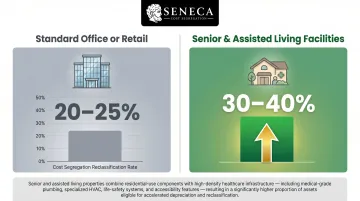
- Expect 20–40% of a facility's depreciable basis to be reclassified due to high-density specialty components
- 100% bonus depreciation is restored under the OBBBA for property placed in service after January 19, 2025, enabling full Year 1 deductions
- Cost segregation works for new acquisitions, properties under construction, and existing holdings via Form 3115 look-back studies with no amended returns needed
What Is Cost Segregation for Senior and Assisted Living Facilities?
Cost segregation is an IRS-approved tax strategy that uses an engineering-based analysis to identify and reclassify building components from their default long-term depreciation schedule into shorter recovery periods (5, 7, or 15 years), accelerating the timing of tax deductions.
Cost segregation doesn't create new deductions: it front-loads deductions that would occur anyway, taking advantage of the time value of money. A dollar saved in taxes today is worth more than a dollar saved 25 years from now — particularly when that cash can be reinvested into additional properties, facility upgrades, or debt reduction. For senior and assisted living owners, where buildings carry significant cost basis, understanding the correct depreciation classification is where the real opportunity starts.
The Classification Distinction Critical to Senior Living Owners
Not all senior living properties depreciate on the same schedule. The IRS draws a clear line based on the services provided:
- Independent living communities (residential housing function): depreciate over 27.5 years
- Assisted living, memory care, and skilled nursing facilities (ongoing care services): classified as nonresidential commercial property, depreciating over 39 years
That longer 39-year baseline is actually an advantage for cost segregation purposes. More of the cost basis sits in the slow-depreciation bucket, which means more is available to reclassify into faster 5-, 7-, or 15-year schedules — and more potential for accelerated deductions.
The IRS Cost Segregation Audit Techniques Guide sets 13 principal requirements for a valid study, including preparation by someone with engineering and construction expertise. Choosing a provider who meets those standards is what keeps a study defensible in the event of an audit.
Why Senior and Assisted Living Facilities Are Prime Candidates for Cost Segregation
The 39-Year vs. Component Lifespan Mismatch
While the building as a whole is assigned a 39-year life, the specialized systems inside — medical-grade wiring, nurse call infrastructure, removable fixtures, accessibility equipment — have functional lifespans far shorter than 39 years and can be legitimately reclassified. Most nurse call systems, for example, become obsolete within 5-7 years, yet they're depreciated over 39 years by default. Cost segregation corrects this mismatch.
Component Density Advantage
Compared to a standard office building or warehouse, senior and assisted living facilities contain a significantly higher proportion of specialty personal property and site improvements per square foot. This means more of the total cost basis is eligible for accelerated depreciation.
Two distinct asset layers drive this advantage:
- Residential-style amenities: kitchens, common rooms, individual unit finishes, flooring
- Healthcare-grade infrastructure: emergency call systems, specialized electrical, accessibility modifications
That combination creates a reclassification density few other commercial property types can match.
Real-World Financial Impact
Industry case studies demonstrate the scale of benefit available:
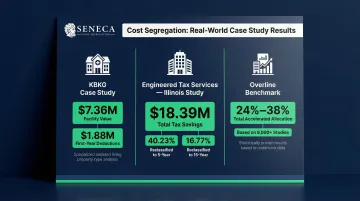
- KBKG's assisted living case study showed $1,882,000 in additional first-year deductions on a $7.36M facility
- Engineered Tax Services' Illinois senior living study demonstrated $18.39M in total realized tax savings, with 40.23% of the basis reclassified to 5-year property and 16.77% to 15-year property
- Overline's benchmark data from 8,000+ studies confirms that senior housing properties typically achieve 24% to 38% total accelerated allocation (14-22% in 5-year property; 10-16% in 15-year property)
Even a 20% reclassification rate on a $10M facility basis generates $2M in accelerated deductions — translating to over $600,000 in immediate federal tax savings at the 37% bracket.
The 2025 Bonus Depreciation Opportunity
The One Big Beautiful Bill Act (OBBBA) permanently reinstated 100% bonus depreciation for qualified property acquired and placed in service after January 19, 2025. This means all reclassified 5-year and 15-year components can be written off entirely in the first year — compressing the entire deduction into a single tax year.
The Operational Case
That timing matters most for senior and assisted living operators, who face compressed margins and ongoing capital demands. Front-loaded tax savings translate directly to freed-up cash — available for staffing, facility upgrades, debt reduction, or acquiring the next property within the same fiscal year.
How a Cost Segregation Study Works: Step-by-Step
A cost segregation study is an engineering-driven forensic analysis of a property's construction and component costs, not an accounting estimate. IRS guidelines explicitly require engineering expertise for a study to be considered reliable.
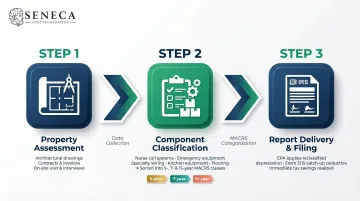
Step 1: Property Assessment and Document Review
The process begins with the engineer collecting and reviewing all relevant documents:
- Blueprints and architectural drawings
- Construction contracts and change orders
- Invoices and cost certifications
- Closing statements and purchase agreements
Engineers conduct a site visit to physically inventory and photograph all building components in their current condition, verifying what was placed in service and when. For senior living facilities, this step is critical — specialty systems that standard commercial studies often undercount are identified here.
Step 2: Component Identification, Classification, and Cost Allocation
Engineers systematically identify each building component, assign it an IRS-approved cost value using standard pricing guides, and classify it into the correct MACRS asset class (5-year, 7-year, 15-year, or 39-year). This includes identifying:
- Nurse call systems and associated wiring
- Emergency response equipment
- Medical gas outlet connections
- Specialty lighting and accessibility features
- Commercial kitchen equipment
- Removable flooring and fixtures
Each component is documented with engineering justification and photographs to create a defensible record.
Step 3: Report Delivery, CPA Coordination, and Filing
The completed study report is delivered to the property owner and their CPA, who applies the reclassified depreciation on the current-year tax return. For properties already placed in service in prior years, the catch-up depreciation is claimed via IRS Form 3115 (an automatic accounting method change) — no amended returns are required.
Seneca Cost Segregation delivers completed studies within 2–4 weeks and includes AuditDefense with a money-back guarantee, so the report is ready when your CPA needs it and defensible if the IRS ever asks.
Key Building Components That Qualify for Accelerated Depreciation
5-Year Personal Property Examples
Common in senior and assisted living facilities:
- Nurse call systems and associated wiring
- Emergency response equipment
- Carpeting and removable flooring
- Specialty and decorative lighting fixtures
- Cabinetry and countertops (removable)
- Medical gas outlet connections
- Window treatments
- Kitchen appliances in resident units or common dining areas
15-Year Land Improvement Examples
- Parking lots and access drives
- Sidewalks and pedestrian pathways
- Exterior lighting
- Landscaping and irrigation systems
- Site drainage systems
- Fencing and security gate infrastructure
- Emergency generator pads and enclosures
What Makes Senior Living Unique
The combination of residential-style amenities with healthcare-grade infrastructure means a higher-than-average proportion of total construction cost qualifies for accelerated treatment compared to typical office or retail properties. A standard office building typically sees 20–25% reclassification; senior living facilities consistently reach 30–40%.
Common Misconceptions and Pitfalls to Avoid
Classification Confusion
Many CPAs and owners assume cost segregation is primarily for residential rentals or standard commercial buildings. The reality: the 39-year commercial classification of most assisted living and memory care properties actually makes cost segregation more impactful. More cost basis sits in the long-depreciation bucket, meaning more is available to reclassify to faster schedules.
The "New Property Only" Misconception
Many owners believe they can only commission a study immediately after acquisition. IRS Form 3115 allows look-back studies on properties acquired years or even decades ago. All missed depreciation is caught up in a single tax year through a §481(a) adjustment — without amending prior returns — often producing a large one-time deduction.
Recapture Concerns
Some owners avoid cost segregation fearing depreciation recapture at sale. Recapture — Section 1245 for 5- and 7-year property, Section 1250 for 15-year property — only triggers at sale. In nearly every scenario, the time value of money makes the upfront tax savings worth more than the eventual recapture cost.
A properly structured 1031 exchange can defer recapture indefinitely, removing the concern altogether for owners planning to reinvest proceeds.
When Cost Segregation Makes the Most Sense — and When to Pause
Strongest Trigger Scenarios
Cost segregation delivers maximum value when:
- You've recently acquired or completed construction of a facility
- You've completed a significant renovation or addition
- You've experienced an ownership change
- You've discovered that the property has never undergone a study
Industry benchmarks indicate that cost segregation is cost-effective for properties with a depreciable basis of $500,000 or more. The ROI on a quality study typically exceeds 10-to-1.
Scenarios Requiring More Planning
Moving forward may require additional tax planning if:
- All real estate activity is passive and there is no passive income to offset
- You don't qualify for Real Estate Professional Status
- You don't have a short-term rental structure
When any of these conditions apply, deductions will carry forward rather than deliver immediate relief. The study still has value — but only if your tax position is structured to use it. Work with a tax advisor to review your passive activity classification and ownership structure before commissioning a study, so the deductions are accessible in the year they're generated.
Frequently Asked Questions
Who qualifies for a cost segregation study?
Any owner of commercial or residential investment real estate with a depreciable basis generally above $500,000 can benefit. For senior and assisted living facilities specifically, both property owners and investors in pass-through entities (LLCs, partnerships) qualify, and the strategy applies whether the property was just acquired or has been held for years.
Is memory care considered assisted living or nursing home?
For tax classification purposes, memory care is generally treated as nonresidential commercial property (39-year depreciation) alongside assisted living. The exact treatment depends on the level of medical services provided and should be confirmed with a tax advisor.
What is depreciation in healthcare?
Depreciation is the IRS-allowed annual deduction for the wear and declining value of a building and its components over time. It reduces taxable income with no cash required — and cost segregation accelerates how quickly those deductions can be claimed.
What is the depreciation life for an assisted living facility?
Most assisted living facilities are classified as nonresidential commercial real property with a 39-year MACRS depreciation life. However, a cost segregation study can reclassify 20–40% of the building's components into 5-year, 7-year, or 15-year categories, significantly accelerating the deductions available to the owner.
Can I do a cost segregation study on a senior living property I've owned for several years?
Yes. Look-back studies are available for properties placed in service in prior years. The catch-up depreciation is claimed in the current tax year using IRS Form 3115, which does not require amending past returns — making it a practical option even for long-held facilities.
How much can a senior living facility save with cost segregation in Year 1?
A $7.36M assisted living facility, for example, generated $1.88M in first-year deductions. Actual savings vary by property size, construction type, acquisition cost, and tax bracket. Contact Seneca Cost Segregation for a complimentary estimate based on your specific property.