What is a cost segregation study and how does it work in Richmond?
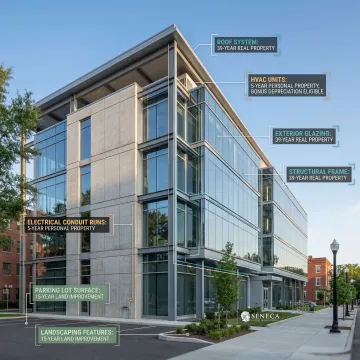
A cost segregation study is an IRS-approved engineering analysis that identifies building components eligible for accelerated depreciation. Instead of depreciating your entire Richmond property over 27.5 or 39 years, we reclassify assets like HVAC systems, electrical work, flooring, and site improvements into 5-, 7-, or 15-year categories. This front-loads your tax deductions, reducing current-year tax liability by 20–40% and freeing capital for reinvestment. The study is completed by licensed engineers who document every component with photos, diagrams, and cost allocations, ensuring full IRS compliance.
What types of Richmond properties qualify for cost segregation?
Most income-producing properties in Richmond qualify, including single-family rentals, multifamily apartments, commercial buildings, retail spaces, office condos, hotels, self-storage facilities, medical offices, and industrial warehouses. Properties must have a depreciable building basis of at least $300,000 (excluding land). Whether you own a historic renovation in Church Hill, a mixed-use building on Broad Street, or a suburban apartment complex, our team tailors the study to your property's unique characteristics and local building practices to maximize your savings.
How much does a cost segregation study cost in Richmond?
Study costs range from $3,000 to $60,000+ depending on property size and complexity. Entry properties ($300K–$1M basis) typically cost $3,000–$12,000 with first-year savings of $30,000–$75,000. Medium properties ($1M–$3M) cost $10,000–$20,000 with $75,000–$200,000 in savings. Large properties ($3M–$10M) cost $15,000–$30,000 with $200,000–$400,000 in savings. Our average client achieves an ROI of 10:1 to 25:1, meaning every dollar spent returns $10–$25 in tax benefits. We provide a free preliminary analysis to confirm the study's value before you commit.
Can I do a cost segregation study on a property I purchased years ago?
Yes. Lookback studies allow you to claim missed depreciation on properties purchased, built, or renovated up to 15 years ago—without amending prior tax returns. Using IRS Form 3115, you capture all missed deductions in one year, creating an immediate tax refund or offsetting current income. Lookback studies cost about the same as current-year studies and include the same engineering analysis, comprehensive reporting, and lifetime audit defense. Our team can reconstruct historical cost data if original records are unavailable.
How long does a cost segregation study take to complete?
Standard studies are completed in 2–4 weeks, significantly faster than the industry average of 4–8 weeks. Virtual property inspections can reduce turnaround to 2–3 weeks by eliminating travel logistics. If you need results faster, our Rush Service delivers studies in as little as one week for urgent tax deadlines. The timeline includes a virtual or on-site inspection (30–45 minutes), engineering analysis, report generation, and a final review with your dedicated account manager to ensure you understand implementation.
What happens if the IRS audits my cost segregation study?
Every Seneca study includes lifetime IRS Audit Defense at no additional charge. If the IRS questions your study, our team handles all communications, provides supporting documentation, and defends the methodology and classifications. This coverage lasts as long as you own the property—not just for a limited term. Our engineering-based approach and strict adherence to IRS guidelines result in a low audit risk profile. If an audit reveals a material issue with our study, we refund your study cost.
Do I need to hire an engineer to perform a cost segregation study?
Yes. The IRS requires cost segregation studies to be performed by qualified professionals using engineering-based methodologies. Our team includes licensed professional engineers and Certified Cost Segregation Professionals (CCSP) who follow American Society of Cost Segregation Professionals (ASCSP) standards. DIY or accountant-prepared studies lack the engineering rigor and supporting documentation needed to withstand IRS scrutiny. Our studies include detailed component identification, cost allocations, photos, diagrams, and legal reasoning that meet all IRS requirements for audit defense.
Will a cost segregation study help me if I already use bonus depreciation?
Yes. Cost segregation amplifies bonus depreciation benefits by identifying more assets eligible for immediate expensing. Without a study, you may only capture bonus depreciation on obvious personal property. A detailed engineering analysis uncovers additional components—like specialty electrical, site improvements, and building systems—that qualify for 100% bonus depreciation under current tax law. This can double or triple your first-year deductions. Even if bonus depreciation phases out, reclassified assets remain in shorter depreciation categories (5, 7, or 15 years), providing ongoing accelerated deductions.