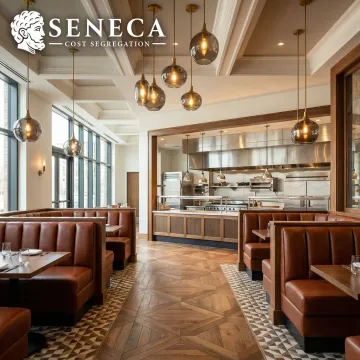
Restaurant owners invest heavily in specialized build-outs, equipment, and fixtures assets that qualify for accelerated depreciation most operators never claim. Seneca Cost Segregation's engineering-based studies identify every dollar of tax savings hidden in your restaurant property, converting 20–40% or more of your building costs into immediate cash flow to reinvest in your business.
Our Cost Segregation Services for Restaurants
Comprehensive cost segregation solutions designed to maximize tax savings for restaurant owners and operators across the country.
Cost Segregation Study
A full engineering-based analysis of your restaurant property that reclassifies assets—booths, kitchen equipment, flooring, lighting, and more into 5, 7, or 15-year depreciation schedules, delivering significant first-year tax savings.
Already own your restaurant building? Claim all missed depreciation from the past 15 years in a single tax year using IRS Form 3115, no amended returns required, no money left on the table.
A convenient 30–45 minute video call inspection of your restaurant space eliminates on-site travel costs and delivers your completed study in 2–3 weeks, minimizing disruption to your operations.
Every restaurant cost segregation study includes Seneca AuditDefense lifetime coverage with IRS inquiry support, documentation defense, and a money-back guarantee if a material issue arises.
Seamless post-study integration with your accountant, including depreciation schedule handoff, Form 3115 support, and ongoing implementation guidance so your tax team can act immediately.
Beyond cost segregation, Seneca's certified advisors identify additional tax-saving opportunities across your restaurant portfolio, partnerships, and business structure at no extra charge.
Turn Your Restaurant Build-Out Into a Tax Advantage
Restaurants are among the most cost-segregation-friendly properties in real estate. Specialized electrical systems, commercial HVAC, exhaust hoods, walk-in coolers, decorative fixtures, and custom flooring all qualify for accelerated depreciation yet most restaurant owners depreciate everything over 39 years by default. Seneca's engineers identify every qualifying component in your space, delivering an average first-year deduction of $171,243 with a typical ROI of 10–25:1 and lifetime IRS audit protection included.
Trusted by Restaurant Owners
Success Stories
See how restaurant operators across the country have recaptured significant tax savings with Seneca's engineering-based studies.
"I couldn't be more pleased with the results. Their team was incredibly professional, prompt, and easy to work with. I achieved a highly favorable tax situation and recommend Seneca to anyone looking to maximize their tax benefits."
Trent H
"The tax savings achieved with Seneca Cost Segregation made a major impact on my bottom line. I wasn't aware it was a possibility until they brought the opportunity to me. Their insight and expertise are invaluable."
Robert Riskin
"Their team was incredibly professional, prompt, and easy to work with."
Trent Hanson
"Seamless experience with great results. Highly recommend!"
Kim Giardino
"I've referred multiple clients to Seneca, and each time they uncovered significant tax savings. Their team is fast, professional, and easy to work with. They've become a trusted extension of our tax strategy."
Eliot Varnum
"I couldn't be more pleased with the results. Their team was incredibly professional, prompt, and easy to work with. I achieved a highly favorable tax situation and recommend Seneca to anyone looking to maximize their tax benefits."
Trent H
"The tax savings achieved with Seneca Cost Segregation made a major impact on my bottom line. I wasn't aware it was a possibility until they brought the opportunity to me. Their insight and expertise are invaluable."
Robert Riskin
"Their team was incredibly professional, prompt, and easy to work with."
Trent Hanson
"Seamless experience with great results. Highly recommend!"
Kim Giardino
"I've referred multiple clients to Seneca, and each time they uncovered significant tax savings. Their team is fast, professional, and easy to work with. They've become a trusted extension of our tax strategy."
Eliot Varnum
"I couldn't be more pleased with the results. Their team was incredibly professional, prompt, and easy to work with. I achieved a highly favorable tax situation and recommend Seneca to anyone looking to maximize their tax benefits."
Trent H
"The tax savings achieved with Seneca Cost Segregation made a major impact on my bottom line. I wasn't aware it was a possibility until they brought the opportunity to me. Their insight and expertise are invaluable."
Robert Riskin
"Their team was incredibly professional, prompt, and easy to work with."
Trent Hanson
"Seamless experience with great results. Highly recommend!"
Kim Giardino
"I've referred multiple clients to Seneca, and each time they uncovered significant tax savings. Their team is fast, professional, and easy to work with. They've become a trusted extension of our tax strategy."
Eliot Varnum
Trusted by CPAs & Real Estate Experts
Partner with Seneca Cost Segregation
Over 10,200+ engineered cost segregation studies completed across the United States.
Average first-year tax deduction: $171,243
"I've referred multiple clients to Seneca, and each time they uncovered significant tax savings. Their team is fast, professional, and easy to work with. They've become a trusted extension of our tax strategy."
"Every client we send their way whether it's their first cost segregation study or their seventh is treated like their most important client. Their team's attention to detail, responsiveness, and genuine commitment to adding value set them apart."
The Seneca Difference
Why Choose Seneca Cost Segregation?
Seneca brings over 12 years of engineering-based expertise, a track record of 10,200+ studies, and a genuine investor's perspective to every restaurant cost segregation engagement.
Engineering-Based Accuracy
Our licensed engineers apply IRS-compliant methodology to identify every qualifying restaurant asset with precision.
Nationwide Coverage
Deployed across all 50 states, Seneca serves restaurant owners from quick-service chains to independent dine-in operators everywhere.
Audit Protection Included
Every study comes with lifetime Seneca AuditDefense and a money-back guarantee at no extra fees, ever.
Investor-Founded Expertise
Co-founded by real estate investors who have personally used cost segregation, we understand the real financial stakes for property owners.
Meet the Seneca Team
Experienced engineers and real estate investors working to maximize your savings.
Dylan Scandalios
Co-Founder and CEO
Dylan Scandalios is an active investor in multi-family properties in the Pacific Northwest and a recognized Cost Segregation Expert. Before founding Seneca Cost Segregation, Dylan closed millions of dollars in business for both public and private companies along the West Coast, developing deep expertise in real estate finance and tax strategy. As CEO, Dylan has helped thousands of real estate investors including office building owners save millions on their federal taxes through engineering-based cost segregation studies. His hands-on investment background means he approaches every client engagement with the perspective of an investor, not just a service provider. Under his leadership, Seneca has completed over 10,200 studies nationwide and achieved a 95% client referral rate.
Paul Spies
Co-Founder
Paul Spies is a Marine Corps Sergeant who brings over 8 years of hands-on expertise in real estate construction to Seneca Cost Segregation. As a Principal Broker and Licensed Contractor, Paul successfully flipped over 150 homes in just four years and led ground-up multi-family development projects across the country. Having leveraged cost segregation personally since 2018 to maximize returns on his own office and residential properties, Paul co-founded Seneca to make the same powerful tax strategy accessible to investors nationwide at an affordable price point and delivered on time. His construction background gives Seneca a unique engineering advantage when analyzing complex office building components and systems.
Howard Hirsch
Chairman
Howard Hirsch serves as Chairman of Seneca Cost Segregation, providing executive leadership and strategic oversight to the firm's continued national expansion. With deep experience in financial services and real estate advisory, Howard helps guide Seneca's direction as it scales its engineering-based cost segregation services to property owners across all 50 states, including California's dynamic real estate market. His leadership ensures the company maintains its commitment to technical excellence, client satisfaction, and IRS-compliant study delivery that protects clients through every phase of property ownership.
Harry Papp
President/Treasurer
Harry Papp serves as President and Treasurer of Seneca Cost Segregation, overseeing the company's operational and financial integrity. His dual role ensures that client investments in cost segregation studies generate maximum ROI through rigorous financial management and disciplined operational processes. Harry's leadership directly supports Seneca's ability to deliver studies on time and within budget a standard that has helped the firm achieve a 95% client referral rate and an average first-year deduction of $171,243 for property owners across California and the rest of the nation.
Merle Rosskam
Merle Rosskam
John Deo
CEO
Frequently Asked Questions
What is the 30 30 30 rule for restaurants?
The 30-30-30 rule is a general guideline suggesting restaurants allocate roughly 30% of revenue to food costs, 30% to labor, and 30% to overhead leaving 10% as profit. Cost segregation directly improves that final margin by reducing federal tax liability through accelerated depreciation on your building and improvements, effectively increasing cash available for reinvestment.
What restaurant assets qualify for cost segregation?
Many restaurant-specific components qualify for 5 or 15-year depreciation rather than 39 years. These include commercial kitchen exhaust systems, specialized electrical wiring, walk-in coolers and freezers, decorative lighting, custom flooring, outdoor signage, landscaping, paving, drive-through equipment, and certain HVAC systems. A qualified engineering study identifies every qualifying component unique to your property.
How much can a restaurant owner save with cost segregation?
Savings depend on your property's depreciable basis. Seneca clients achieve an average first-year deduction of $171,243, with typical ROI of 10–25:1. A restaurant property with a $1M–$3M building basis can generate $75,000–$200,000 in first-year tax savings, while larger properties of $3M–$10M often see $200,000–$400,000 in year-one deductions.
Can I do a cost segregation study on a restaurant I purchased years ago?
Yes. Seneca's lookback cost segregation studies cover properties placed in service up to 15 years ago. Using IRS Form 3115, you can claim all previously missed depreciation deductions in a single tax year without filing amended returns. The lookback study process and pricing are comparable to a current-year study, and a free preliminary analysis confirms your eligibility.
Does cost segregation apply to leasehold restaurant improvements?
Yes, qualified restaurant property and qualified improvement property (QIP) can often benefit from accelerated depreciation, including bonus depreciation provisions. If you own the building or have made significant capital improvements to a leased space, many of those costs may qualify. Seneca's engineers assess both owned and improved properties to identify every available deduction.
How long does a restaurant cost segregation study take?
Most Seneca restaurant studies are completed within 2–4 weeks, faster than the industry standard of 4–8 weeks. Virtual property tours a 30–45 minute video call, reduce the timeline to 2–3 weeks. Rush service is available for tax deadline situations, delivering studies in as little as one week. You receive a dedicated account manager throughout the process.
Is cost segregation IRS-approved, and will it trigger an audit?
Cost segregation is a fully IRS-approved tax strategy with decades of case law support. Seneca's engineering-based methodology and strict adherence to IRS guidelines result in a low audit-risk profile. Every study includes Seneca AuditDefense at no charge providing lifetime IRS inquiry defense, documentation support, and a money-back guarantee if any material issue is found in the study.
What is the minimum property value to make cost segregation worthwhile for a restaurant?
Cost segregation becomes cost-effective for restaurant properties with a depreciable building basis of $300,000 or more (excluding land value). Below that threshold, study fees may outweigh the tax benefits, and Seneca will tell you honestly in a free preliminary analysis. For properties above $300K, the ROI typically ranges from 10:1 to 25:1, making it one of the highest-return tax strategies available.
Still Have Questions About Restaurant Cost Segregation?
Talk to a Seneca engineer for a free consultation and savings estimate tailored to your restaurant property.
Serving Restaurant Owners Nationwide
Seneca Cost Segregation serves restaurant owners and commercial property operators across all 50 states with on-site and virtual study options.
We serve restaurant owners in every state, virtually or on-site. Confirm your eligibility today.
Certified & Trusted
Awards and Recognition
ASCSP Membership
Member of the American Society of Cost Segregation Professionals.
CCSP Designation
Certified Cost Segregation Professional designation from ASCSP.
5.0 Client Rating
Five-star average rating from satisfied clients nationwide.
Get Your Free Restaurant Cost Segregation Estimate
Tell us about your restaurant property and we'll provide a no-obligation savings estimate and ROI analysis typically within 24 hours. No commitment required.