How much does a cost segregation study cost in California?
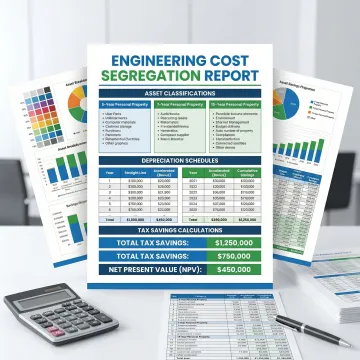
Cost segregation study costs in California vary based on property size, complexity, and type. Entry properties ($300K-$1M basis) typically cost $3,000-$12,000, medium properties ($1M-$3M) cost $10,000-$20,000, large properties ($3M-$10M) cost $15,000-$30,000, and very large properties ($10M+) cost $30,000-$60,000+. Most Sacramento clients achieve a 10-25:1 return on investment, meaning every dollar spent returns $10-$25 in tax savings. We provide a free preliminary analysis to confirm your property's potential savings justify the study cost before you commit.
What types of Sacramento properties qualify for cost segregation?
Any income-producing property in Sacramento with a depreciable basis of $300,000 or more typically qualifies. This includes apartment complexes, office buildings, retail centers, hotels, self-storage facilities, medical offices, industrial properties, car washes, restaurants, gas stations, and even single-family rentals or short-term vacation rentals. Both purchased and newly constructed properties qualify, as do renovated properties where significant capital improvements were made. The property must be held for business or investment purposes—owner-occupied businesses where you own the building also qualify for substantial savings through cost segregation.
Can I do a cost segregation study on a property I purchased years ago?
Yes, through a lookback cost segregation study. Sacramento property owners can claim missed depreciation on properties purchased, constructed, or renovated up to 15 years ago using IRS Form 3115. This allows you to capture all prior-year missed deductions in one year without amending previous tax returns. The lookback study process is identical to current-year studies, includes the same engineering rigor and audit defense, and costs approximately the same. Even if you don't have original records, our team can reconstruct property information using industry databases and historical cost data to complete your analysis.
How long does a cost segregation study take to complete?
Seneca completes most cost segregation studies within 2-4 weeks, significantly faster than the industry standard of 4-8 weeks. Virtual property tours typically result in 2-3 week turnarounds, while on-site inspections may take 4-6 weeks. For Sacramento clients with urgent tax deadlines, we offer rush service that can deliver completed studies in as little as one week. The timeline depends on property complexity, documentation availability, and whether you choose virtual or on-site inspection. Your dedicated account manager will provide a specific timeline estimate during your free consultation based on your property's characteristics.
Will a cost segregation study trigger an IRS audit?
Cost segregation studies have a low audit risk profile when properly engineered and documented. Our engineering-based methodology strictly follows IRS guidelines, Tax Court precedents, and cost segregation audit techniques guide standards. Every study includes comprehensive supporting documentation, detailed engineering analysis, and cost reconciliation that ties back to your purchase price. Additionally, every Seneca study includes our AuditDefense guarantee at no extra charge—if the IRS questions your study, we defend it and handle all communications for as long as you own the property. Our 10,200+ completed studies demonstrate our proven compliance track record.
What's included in the final cost segregation report?
Your comprehensive report includes detailed property inspection documentation with photos and diagrams, engineering analysis identifying all reclassifiable assets, cost allocations using industry best practices, organized depreciation schedules separating property into 5-year, 7-year, 15-year, and standard categories, a narrative report explaining classification decisions and legal reasoning, cost reconciliation workpapers proving all numbers tie to purchase price, Form 3115 preparation if needed for lookback studies, fixed asset schedules formatted for your CPA, and complete audit defense documentation. The report is delivered in both PDF and Excel formats for easy implementation by your tax professional.
How do I implement cost segregation findings with my CPA?
Implementation is straightforward with our included CPA coordination support. After study completion, we schedule a coordination call with you and your tax professional to review the report and answer questions. For current-year studies, your CPA simply uses our provided depreciation schedules when preparing your tax return. For lookback studies, we provide a completed Form 3115 that your CPA files with your current return to claim all missed prior-year depreciation in one year. Our team remains available post-study to provide ongoing implementation support to ensure your tax professional can confidently integrate the findings into your tax strategy.
Is cost segregation worth it for smaller rental properties in Sacramento?
Cost segregation becomes cost-effective for properties with a building basis starting at $300,000 (excluding land value). For smaller Sacramento rental properties, we provide a free preliminary analysis to determine whether the study fees justify the tax benefits. Properties under $300,000 require careful analysis—factors like recent renovations, high-quality improvements, or upcoming property sales can make studies worthwhile even for smaller properties. Our average client achieves first-year savings of $171,243, and even entry-level properties ($300K-$1M) typically see $30,000-$75,000 in first-year deductions, far exceeding the $3,000-$12,000 study cost for an impressive ROI.