What is asset reclassification in real estate?
Asset reclassification is an engineering-based analysis that identifies property components eligible for accelerated depreciation. Rather than depreciating an entire building over 27.5 or 39 years, this process separates assets like electrical systems, flooring, and landscaping into 5, 7, or 15-year categories as defined by IRS guidelines. This legal strategy dramatically increases early-year deductions, with property owners typically converting 20-40% of their building costs into immediate tax savings. The reclassification is supported by detailed engineering documentation and follows established IRS cost segregation methodologies recognized since the 1997 Hospital Corporation of America case.
How does asset reclassification impact my taxes?
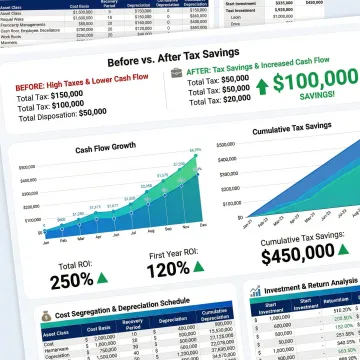
Asset reclassification accelerates depreciation deductions, significantly reducing taxable income in the first year and subsequent years. On average, our clients achieve $171,243 in first-year deductions, with ROI ratios typically ranging from 10:1 to 25:1—meaning every dollar invested in the study returns $10-$25 in tax savings. For a $2 million property, reclassification might identify $800,000 in assets eligible for 5-15 year depreciation instead of 39 years, creating immediate deductions of $150,000-$250,000 in year one. This front-loaded benefit improves cash flow, reduces tax liability, and frees capital for reinvestment or debt reduction.
Is asset reclassification audit-proof?
When performed by qualified engineering professionals following IRS guidelines, asset reclassification studies have a strong audit defense profile. Our studies use detailed engineering cost estimation, comprehensive property documentation, and strict adherence to established tax court precedents. Every Seneca study includes lifetime IRS audit defense at no additional charge—our specialists will respond to field inquiries, provide supporting documentation, and defend the methodology for as long as you own the property. We back this with a money-back guarantee: if an audit occurs and our study has a material issue, we can refund your study cost. Our 12+ years and 10,200+ studies demonstrate our commitment to defensible, compliant work.
Can I reclassify assets on properties I purchased years ago?
Yes, through lookback cost segregation studies using IRS Form 3115. This allows you to recapture missed depreciation from properties purchased, constructed, or renovated up to 15 years ago without amending prior tax returns. All missed depreciation is claimed in one year as a catch-up deduction, providing a significant one-time tax benefit. Lookback studies cost approximately the same as current-year studies and follow identical engineering analysis processes. Even if you've lost original documentation, our team can reconstruct property information using industry databases and historical cost data to support the reclassification.
What property types qualify for asset reclassification?
Nearly all income-producing real estate with a depreciable basis of $300,000 or more qualifies for asset reclassification. Eligible property types include residential rentals (single-family, multi-family, apartments), commercial buildings (office, retail, industrial), hospitality properties (hotels, resorts), specialized facilities (self-storage, medical offices, auto dealerships, assisted living), and owner-occupied businesses. Properties under $300,000 require careful ROI analysis to ensure study fees justify tax benefits. Land itself doesn't qualify as it's non-depreciable, but all building structures and improvements do. Our team has successfully completed studies on over 10,200 properties across all 50 states, covering virtually every real estate asset class.
How long does an asset reclassification study take?
Standard studies are completed within 2-4 weeks, significantly faster than the industry average of 4-8 weeks. Virtual property inspections typically result in 2-3 week turnarounds, while on-site visits may take 4-6 weeks depending on property complexity and scheduling. For urgent needs, we offer rush service that can deliver complete studies in as little as one week, though premium pricing applies. The timeline includes property inspection, engineering analysis, report generation, and CPA coordination. Our proprietary technology and streamlined processes enable faster delivery without sacrificing accuracy or IRS compliance standards.
What is included in an asset reclassification study?
A comprehensive study includes: free initial consultation and ROI analysis; virtual or on-site property inspection with detailed documentation; engineering-based identification and classification of all qualifying assets; cost allocation using industry-standard estimation techniques; comprehensive narrative report with legal justifications, diagrams, and photos; organized depreciation schedules by asset category (5, 7, 15, and 27.5/39-year); year-by-year deduction projections; cost reconciliation tying all figures to purchase price; Form 3115 preparation for lookback studies; CPA implementation support; and lifetime IRS audit defense with money-back guarantee. Each client receives a dedicated account manager and ongoing support for questions throughout property ownership.
How much does asset reclassification cost versus savings?
Study costs range from $3,000-$60,000+ based on property size and complexity, while typical first-year savings range from $30,000-$400,000+. Entry properties ($300K-$1M basis) cost $3,000-$12,000 with $30,000-$75,000 savings. Medium properties ($1M-$3M) cost $10,000-$20,000 with $75,000-$200,000 savings. Large properties ($3M-$10M) cost $15,000-$30,000 with $200,000-$400,000 savings. Very large properties ($10M+) cost $30,000-$60,000+ with savings reaching several million dollars. Most clients achieve 10-25:1 ROI. We provide free preliminary analysis to determine exact costs and projected savings before you commit, ensuring the investment makes financial sense for your specific property.